My Nephew Wanted Me to Sign Away the Shed. My Late Husband Had Recorded Our Names in 1994
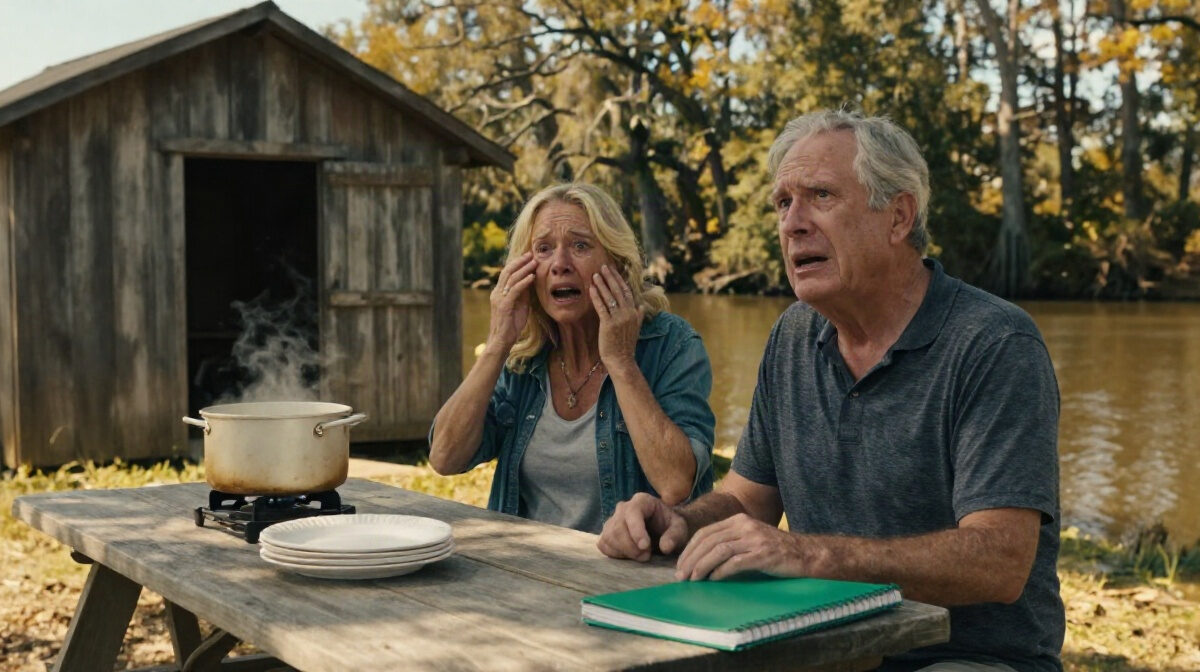
Remy slid the papers across the table, between the bowl of boiled crawfish and the pitcher of sweet tea. The stack was thick, and the top page had a yellow tab stuck on it, right where I was supposed to sign.
“Tante Marguerite, it’s just a formality,” he said. He said it fast, the way he always did, like a man selling a used truck. “You sign as heir. Ray never finished the paperwork on the shed. That’s all this is.”
I looked at the stack and then at my nephew. Remy was forty-four years old, the son of my sister Cecile, who had been gone nine years now. He had a round face and an easy laugh, and he had been behind on his mortgage since spring.
Across from him sat his wife, Dana, her hands folded around a glass she had not touched. She looked toward the bayou and did not say a word.
The burners on Ray’s boiling shed still ticked as they cooled. Ray had built that shed by hand in 1993, with a metal roof, two long picnic tables, and a walk-in cooler he was proud of until the day he died.
He died in March 2025, at seventy, of a heart attack in the yard.
“Ray never finished it?” I said.
“That’s what the lawyer says,” Remy said. “Preston Landry. He’s a good man. He’s here.”
A gray sedan pulled up under the oak tree, and a man in a pressed blue shirt got out. He had a leather folder under one arm and walked up the gravel like the ground owed him money. He was about forty-eight, I guessed, and he smiled at me the way men smile at a cashier who is taking too long with the change.
“Mrs. Doucet,” he said, and put out his hand. “Preston Landry. I represent the buyers. Three hundred eighty-five thousand for the parcel, as Remy has explained. Cash closing. We need everything filed by October ninth.”
“Three hundred eighty-five thousand,” I said. “That’s a lot of crawfish.”
He laughed like I had told a good joke. Then he set the folder on the table and opened it. Inside was another deed, typed and crisp, with a signature line already waiting for me.
I did not argue. I had spent thirty-one years as a court stenographer in St. Martin Parish, and I had learned that people say more when they think you are not listening. So I reached down beside my chair, where my purse sat, and took out my shorthand notebook. I opened it on my lap, under the edge of the table.
I wrote every word. I wrote “as heir.” I wrote “never finished.” I wrote “October ninth” and “Friday, as a formality.”
Remy never once asked me what Ray had written down about the shed.
“The clerk’s office can record it on Friday,” Preston said, tapping the folder with one finger. “It’s a formality, like I said.”
He slid the quitclaim toward me. I looked at the seal printed on the folder cover. It was the seal of a title company in Lafayette.
Ray had always filed at the Clerk of Court in New Iberia. I knew that because I had watched him drive there in a clean white shirt and come home with a receipt folded in his pocket.