My Son Wanted to Sell the Farm His Father Built. Then I Found the Letters He Hid for Forty-Five Years
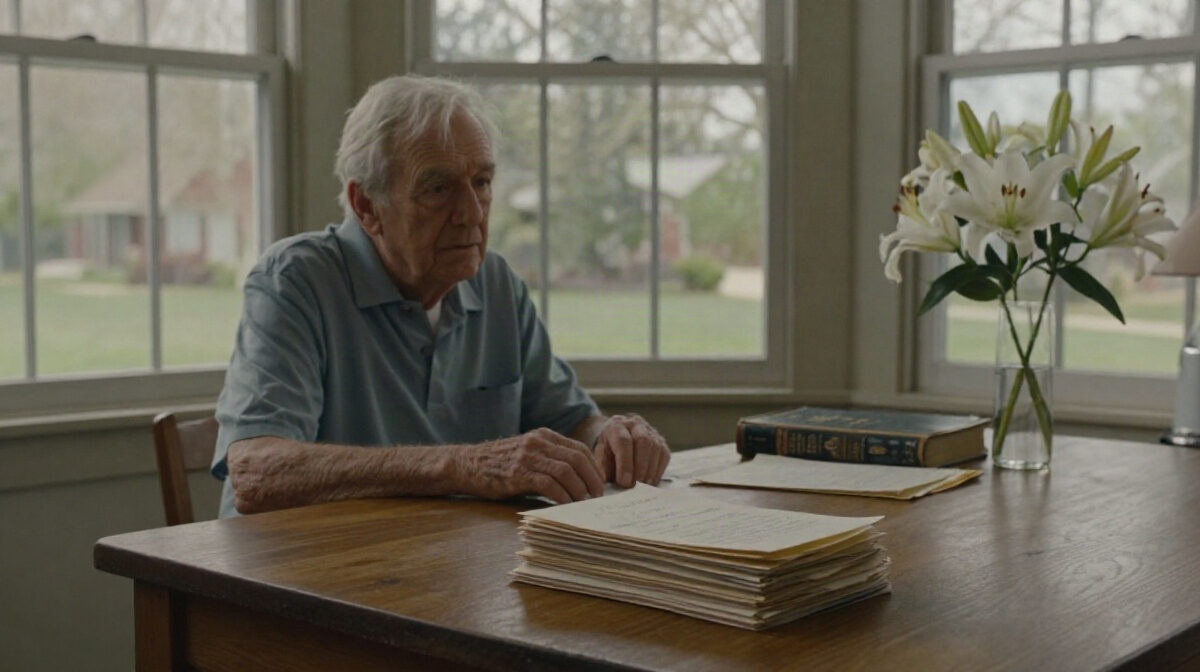
The envelope slid out of the book before I even knew what I was holding. Forty-one pages, folded in thirds, all in Homer’s square carpenter’s capitals. I knew that handwriting better than my own.
I was standing in the nursing home’s small library on the Friday before Mother’s Day, and my hands were shaking. Janet Delaney, my oldest friend in this building and the only person who could make me laugh on a bad day, was across the room stacking large-print mysteries.
It started simply enough. Otis Vance, Homer’s oldest friend, had asked me that morning to bring back his bird book. “Homer gave it to me in 1985,” he said, tapping the cover with a bent finger. “Tell him I finished it.”
I had to explain, gently, that Homer had died in March. Otis nodded, then asked again an hour later, and I said yes again.
So I went looking for it on his shelf. His roommate had moved to the second floor last winter, so the room was quiet. The field guide was thick and soft at the corners. When I lifted it, it fell open, and the letters slid onto the carpet like something alive.
“Janet,” I said. My voice came out small. “Come look at this.”
She knelt beside me with her knees popping. We read the first line together. “Lorrie, I have not said the things I mean to say, so I am writing them down where you can read them at your own speed.” Janet sat back on her heels and let out a long breath.
I need to tell you how I got to this place, because it matters.
I taught eighth-grade English for thirty-four years in Ligonier, and I kept everything in order. Lesson plans, report cards, Christmas cards in shoeboxes labeled by year. Homer was the opposite. He built our farmhouse with his own hands in 1981 on fifteen acres just outside town. He could fix a fence in the dark, but he could not say “I love you” over the supper table.
He wrote it down instead. I found a note in my lunch sack most days for forty-five years.
We married in June 1979 at St. Mark’s, and Shane came along in 1982. Shane grew up on the farm. He worked the fields with his father and then went off to cook in a restaurant in Pittsburgh. When the restaurant closed, he came home owing money to everyone, and he has been worried about money ever since.
That was the state of things when Homer got sick in the fall of 2024. He sat me down in the kitchen one evening and said, “I want to make it plain who gets the house.” He wrote it out by hand on lined paper. Robert, my nephew and a notary who never bends a rule, came out to witness it with Janet. He stamped it with his number, 4417, and filed the paperwork. Homer folded it into the cedar box in our bedroom closet, and that was that.
Homer died in March. We buried him beside his parents on a gray morning with the forsythia just starting to show yellow. I thought the hard part was over.
On Friday afternoon, Shane came into the solarium while I was still holding the letters. He had a manila folder under his arm and a look on his face I knew from when he was ten and had broken a window.
“Mom, we need to talk about the farm,” he said. He put the folder on the table. “I’ve talked to a realtor. The place is worth about $380,000 on the open market. That’s the only sensible thing to do. We sell, we pay off my debts, and you get to move somewhere easier.”
“Easier,” I said. “Shane, I have lived on that land for forty-five years.”
He pulled out a stack of papers and turned them to face me. “Dad wasn’t himself when he wrote that will. Everybody saw it. The lawyer says we have grounds to contest it. Confused, the lawyer says. Dad was confused.”
I looked down at the sale papers, then at the will copy clipped to the back. The notary stamp in the corner read 4417, the same number printed on the first letter in my hand.
Janet, beside me, went very still.