The Cousin Who Wanted to Sell Her Father’s Medal Had Locked Away His Last Wish
The waiting room at Hart County Memorial had one window unit, and it was losing the fight. It was July 16, the afternoon was past ninety-five degrees, and the air smelled like floor wax and burnt coffee. My niece Ruthie sat with her clipboard of bills in her lap, pressing so hard on the paper that the pen had worn a hole through the top sheet.
“They said two hours,” Dale said. He stood up, sat down, and stood up again. He was a good welder with big, careful hands, and right now those hands did not know what to do. “Two hours, and then they’ll tell us Caleb’s going to be fine. He’s going to be fine. I’ll handle everything, Ruthie. All of it.”
Caleb was nine years old. Two days before, he had been riding the old Ford tractor across the lower pasture on my farm, the one with the bad brake, and it rolled on the slope by the creek. He had a broken leg and was bleeding inside, and the surgeon had taken him back at noon. Nobody had said much since.
I had been sitting in the corner chair since eleven. I am sixty-four years old, and I don’t talk much unless I have something to say, so mostly I listened. That is how I learned about the money.
Pastor Lonnie Hobbs came through the double doors at a quarter past two carrying two foil pans and a canvas grocery bag. He set the pans on the side table and said, “Mount Gilead ladies made chicken and rice. Doris sent the pound cake. Don’t argue with Doris.”
“Lonnie, you didn’t have to,” Ruthie said.
“Yes, I did. The prayer chain has been going since last night. Forty-some people have called me. We have the meal train sorted through next Sunday, and there’s a card going around the congregation.” He patted her shoulder. “You’re not in this by yourself, honey.”
Juanita Baker, the hospital volunteer, came in behind him with her tin of peppermints. She passed them around without asking, the way she always did, and sat down next to me without a word. She had a stack of prayer cards tucked under one arm, and she gave one to Ruthie, who held it like it might burn her.
Then the glass door opened, and Carla Denton walked in with a black binder against her chest. She wore pressed slacks and a sleeveless blouse, and she looked at the room the way a bank examiner looks at a ledger.
Carla was Ruthie’s first cousin, a few years younger and a good deal more sure of herself. After Wade died in 2003, she had helped the family with the estate paperwork, and she had kept every file since. Nobody had ever asked her to.
“Ruthie, we need to talk about the medal,” she said. She did not sit down.
Ruthie went white. “Not today, Carla. Please.”
“It’s the only day we have. The bill from the first surgery came to fourteen thousand two hundred dollars, and there’s a second one coming. The farm is in the estate. The house is in the estate. And the Bronze Star is in the estate, too, unless somebody wants to tell me otherwise.” She opened the binder and turned it toward Ruthie. “It needs to be sold to cover the debt. Uncle Wade would understand that.”
“Uncle Wade gave that medal to me,” Ruthie said quietly. “It’s in his will. It’s mine.”
“It says that in the will. But the debt doesn’t care what the will says.” Carla’s voice was sharp but not cruel. “I’m trying to help you, Ruthie.”
Dale stood up so fast his chair scraped the tile. “We’ll handle it. I said I’d handle it.”
I said nothing. I looked at my hands, cracked and brown from forty years of hay and tobacco and dairy work, and I thought about the cedar box on the shelf in my front room.
Wade had carried that box home from Vietnam in 1971. He was nineteen when he went over, and he came back a grown man who never talked much about what he saw. He had earned the Bronze Star with V device in 1970, and the medal had sat in that box ever since, next to a folded prayer card from his unit chaplain.
I had never opened the box in all these years. It was not mine to open. But right then I stood up, took my hat off, and said, “Carla, I’m going home to get something for Ruthie. I’ll be back before the surgeon comes out.”
Carla narrowed her eyes at me. “Earl, what could you possibly bring that matters?”
“Something Wade left,” I said. “Something he wanted her to have.”
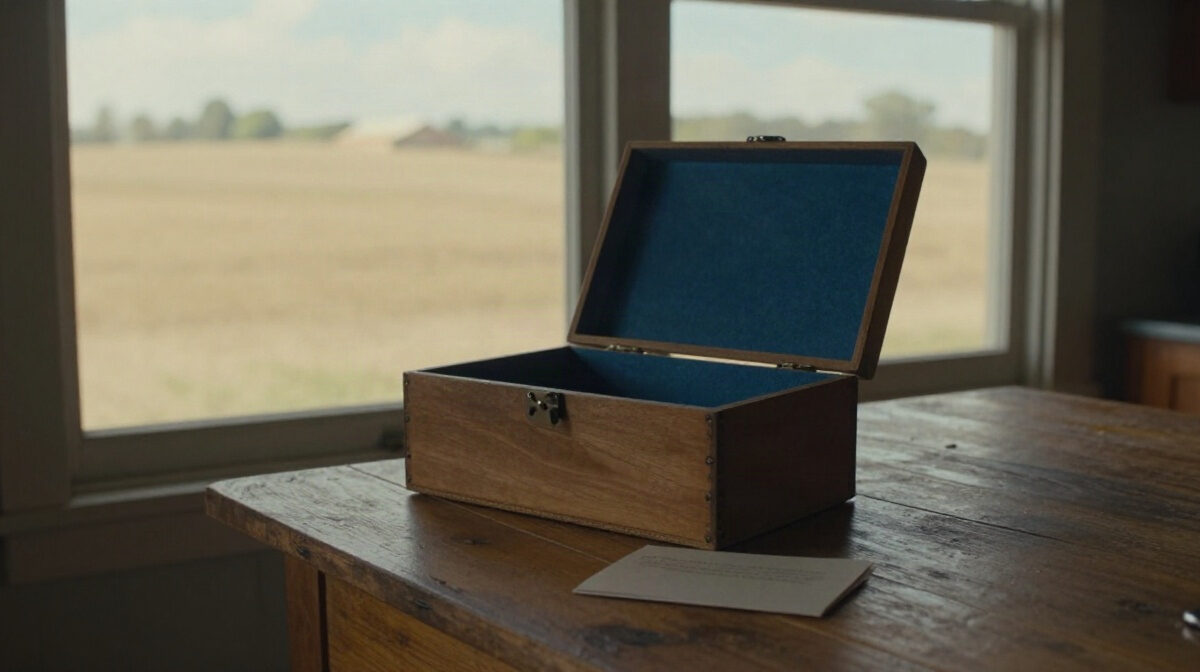
I drove the four miles home with the windows down and the hot wind pushing across the seat. The hayfield along the road had turned gold in the heat. At the house I went straight to the front room, lifted the cedar box from the shelf, and carried it to the kitchen table.
The medal lay on a bed of faded blue felt, the ribbon as bright as the day it was pinned on. I lifted it out gently and set it aside. The folded prayer card was underneath, soft at the creases and the color of weak tea.
I unfolded it. On the front was a small picture of a cross and a verse I half remembered. I turned it over.
There were words on the back in Wade’s square, careful handwriting. I read the first line, then read it again, and my throat went dry.
The word at the top, underlined twice, was CODICIL.
Out the kitchen window I saw a silver sedan turn off the highway and roll up the farm lane behind my truck. It was Carla’s car, and it was coming fast.