A Retired Mail Carrier Opened His Route Book in the Gym. Then Two Dozen Neighbors Stood Up
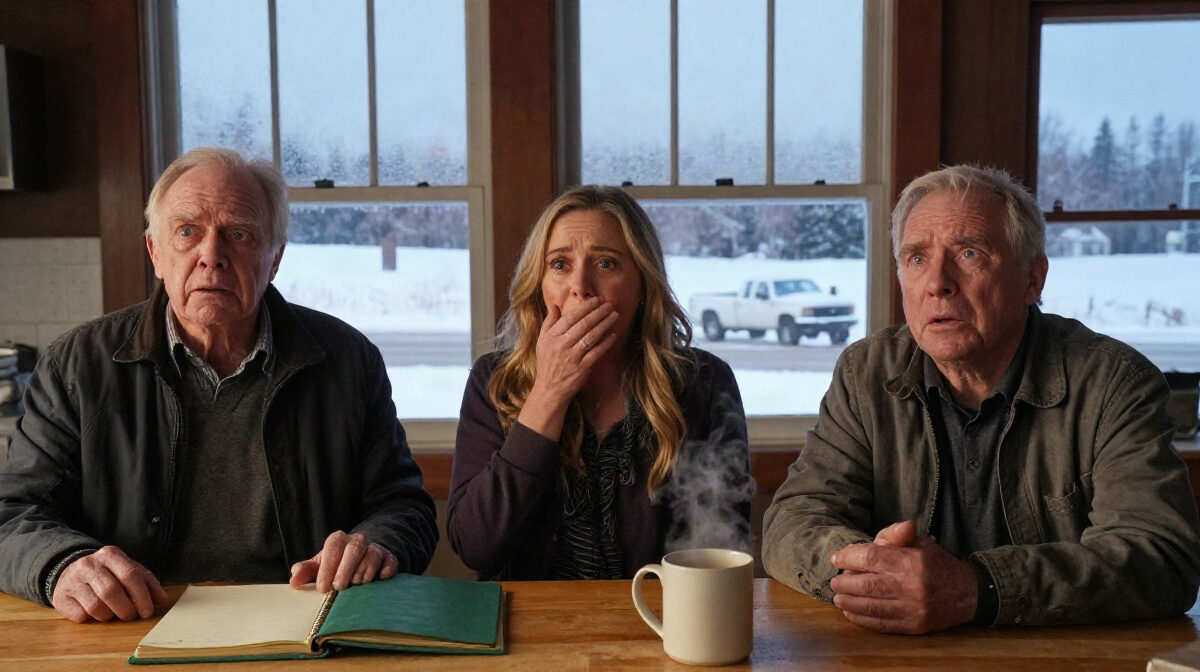
The snow came sideways across County Road 9, and I almost missed the box truck in the ditch. Its back wheels were buried to the axle near the Cedar Creek bridge. The headlights were still on, glowing into the storm like two tired eyes.
I had my tractor out to clear the drive, and I stopped it right there in the road. A girl stood beside the cab with her arms wrapped around herself. She had no hat and no gloves, and her face was white with cold.
“Are you hurt?” I shouted over the wind.
“No, sir,” she said. “Just stuck.”
I got her into the tractor cab and drove her the four miles home to the farmhouse. The power had not gone out yet, but the sky was already the color of dishwater. It was only half past five.
My wife Marlys lay in the hospital bed in the front room, which we had set up in October when the hospice people came. She is seventy-eight years old. The cancer has taken most of her strength, but not her voice. She took one look at the girl dripping on our kitchen rug and said, “Walter, get her a towel and put the coffee on. Then go find her a pair of Peter’s old wool socks.”
Her name was Tessa Villareal. She was seventeen, and she drove a delivery route for a grocery distributor out of Ostrander. She had been loading frozen goods at the depot when the blizzard started at one o’clock. Her boss told her to get the load to the stores before the roads closed.
“I should have stayed at the depot,” she said. She wrapped both hands around her cup. “My mother will be frantic.”
“Call her,” Marlys said from the other room. “Use the landline. Tell her you are with the Ferrantes and you are warm.”
Tessa called. I heard her speak in Spanish, soft and careful, and then in English for my benefit. Her mother’s name was Rosa. Rosa cleaned offices at night in Halvorsen. Tessa had come to Minnesota when she was nine years old.
We ate canned soup and sliced bread at the kitchen table. The power went out at ten minutes past four. The furnace quit, and the house went quiet except for the wind against the north windows. We lit the propane heater in the front room, because Marlys needed the warmth, and the morphine pump needed power from its battery to keep running.
The next morning, Dale Oberg came up the drive in the county truck. He is the sheriff, and he went to school with our son Peter. He is a careful man who does not like to bring bad news. He took off his cap at the door like he was walking into a church.
“Walt, Marlys,” he said. Then he looked at Tessa. “Young lady, I’m sorry, but I’ve got to talk to you about some things.”
He explained that the county shelter at the Community Center gym could only take people with proof of legal residency for overnight placement during non-emergency activations. The county attorney had told him an undocumented minor could not be sheltered at county expense.
“This is an emergency,” I said.
“Walt, I know it is,” Dale said. “But the rule says non-emergency activations, and the county board decided what counts. I don’t like it. I’m telling you what I was told.”
Then he took a folded paper from his coat. It was a tow order for the abandoned truck in the ditch on County Road 9. The county would haul it out on Friday, and the grocery distributor would have to pay the fees.
Tessa did not argue. She only nodded. She had a learner’s permit from Minnesota and a valid consular ID from Michoacán, but no driver’s license. She knew as well as I did what a county tow order could cost her family.
“I’m sorry,” Dale said again, and he left his card on the table.
When he had gone, Tessa slid the card back toward the edge of the table with two fingers. Her hands were shaking.