A Retired Mail Carrier Opened His Route Book in the Gym. Then Two Dozen Neighbors Stood Up
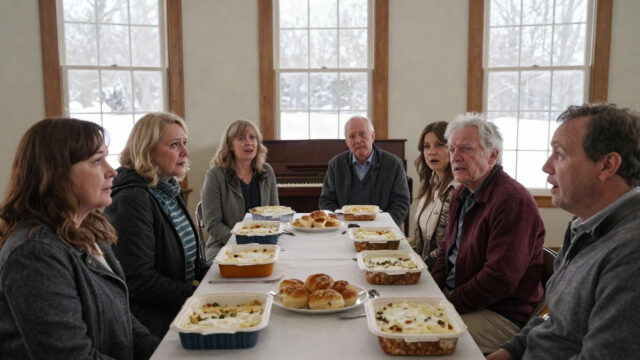
On Thursday night, the Halvorsen Community Center gym was full. There were folding chairs in every row, and people stood along the back wall. The air smelled of wet wool and coffee, and the basketball hoops were pulled up high against the ceiling.
Marlys could not come. Janelle had told us she was too weak to sit up for long, so I had promised to tell her everything. Tessa sat beside me in the front row with her hands folded in her lap. Rosa sat behind us, straight and proud, with her hands in her coat pockets.
Dale Oberg stood at the front with the county attorney beside him. He asked me to speak first, and I did not use notes. I held up the route book.
“I carried this ledger for fifty-one years,” I said. “I wrote down everything I saw on my route. I know every dog, every mailbox, and every child in the township. This is not a document for the county. It is our town’s memory.”
I read the entries aloud, one at a time. I read about Gene’s dog, Duke, and the grader that never came. I read about Carmen’s parents and their corn. I read about the box of quilting fabric and the girl named Tessita who waited at the box every afternoon.
Then the people began to stand. Gene was first. He rose with his hat in his hands and said, “Yes, I know Rosa and her girl.” Carmen stood next, holding her clipboard high. After that, the chairs scraped and rose all over the gym until two dozen families were on their feet, and then more.
Dale looked at the crowd for a long time. Then he walked across the floor to where Tessa sat, and he took the tow order out of his coat.
He tore it in half. Then he tore it again, and he dropped the pieces into the wastebasket by the bleachers.
“That’s the county’s answer for today,” he said quietly, loud enough for the back rows to hear. “I’ll take the rest of it up with the board myself.”
The county board met the following week. They voted to amend the intake rule for emergency activations, so that no family in a blizzard or flood could be turned away from county shelter because of paperwork. The vote was four to one.
Marlys heard the news from Janelle on Saturday. She squeezed Janelle’s hand and asked for a hymn. Tessa sang it beside her bed in Spanish, low and steady, the way Marlys had taught her to sing the old songs in the church choir.
Marlys died in February, very early on a cold morning, with the propane heater humming and the snow still piled against the north windows. Tessa was holding her hand. Rosa stood at the foot of the bed, crying quietly, and I sat in my chair and listened to them both.
In March, Tessa walked into the Halvorsen High School driver education room with her permit and a new notebook. She had asked the school for a place in the course, and they gave her one without any argument. On Saturdays, she rode with me on Route 4. She carried the mail bag over her shoulder as I checked the boxes along County Road 9.
The road still runs past the Cedar Creek bridge, and the boxes still have names on them. I know them all, and so does she. A route is more than the miles you drive. It is the people who wait for you at the end of it, and who wait for you to bring their mail right.
This is a work of fiction. Names, characters, places and events are products of the author’s imagination; any resemblance to actual persons or events is purely coincidental. Images are illustrations.