He Called Her Sweetheart Fourteen Times. She Called the Bank Instead
On Saturday, October 24, the first frost had whitened the fields all the way to the tree line. The wind came hard from the northwest, and the sky was the color of old dishwater. I put the coffee on at nine.
At about half past ten a silver car pulled into the drive, followed by a gray sedan with a woman in the passenger seat. Gavin came up the cracked gray step in his good leather shoes, carrying a folder. Pam Oestreich, the notary he had hired, followed with a stamp in her purse and a sealed envelope of forms.
“Morning, sweetheart,” Gavin said, as warm as ever. “Ma’am, we’re going to make this easy.”
“Come in and sit down,” I said. “I’ll pour you a cup.”
They sat at the oilcloth. I poured the coffee and set out the sugar. Then I read every form aloud, the way Gavin had asked me to, in my own careful voice. I read the power of attorney. I read the transfer authorization. I read the fine print that had been designed to be skimmed.
Gavin grew restless. “Ma’am, it’s all standard,” he said. “We just need your signature right here.”
He pointed to the line with his pen, and I reached for my apron pocket. Inside were the green spiral notebook and copies of the deposit slips, folded small.
I slid them across the oilcloth, past the coffee cups, to the far end of the table. A sheriff’s deputy had come up the porch steps without a sound. Deputy Renee Ashcraft had been waiting in her Buick at the end of the drive, and she stood in the doorway now with her hat in one hand.
“Mr. Mercer,” she said, calm as a Sunday, “I’m going to need you to come with me.”
Gavin stood up slowly and looked at me as if he could not believe a widow had beaten him. I just looked back and said, “Those are good shoes, but you should have read the fine print.” He did not say another word. The deputy walked him out to the cruiser without a scene.
Pam Oestreich went white and told the deputy she had only been paid to witness a signature. She was questioned at the table and released that same afternoon.
Renee Ashcraft took the notebook, the slips, and the blank authorization copy, and logged each one as evidence. In the weeks that followed she traced the transfers to an account in Zanesville at a credit union, held in the name of Gavin’s sister. Gavin’s real name was Kevin Dorsey. He had been charged with fraud in Pennsylvania back in 2019, though the case had been dismissed.
Mr. Brandt called me in early December. Peoples National restored the full $38,500 to Owen’s education account under its emergency reimbursement policy, within sixty days of my report.
Tom came to the farmhouse the next Sunday and sat at the oilcloth with his hat in his lap. “Bernice, I am sorry,” he said. “I should have listened to you before I listened to him.”
“You listened to me when it counted,” I told him, and I poured him a cup of coffee.
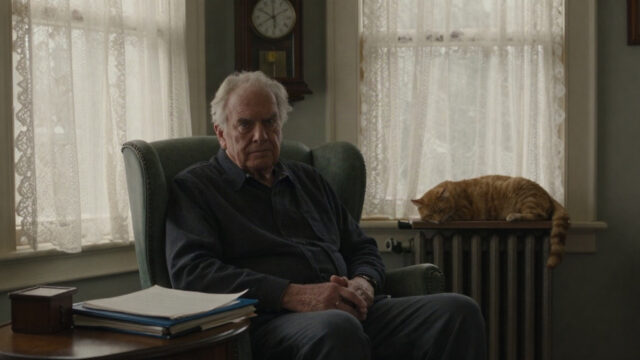
On Monday, November 17, a letter came in the mailbox. It was on lined paper, postmarked Columbus, in Owen’s square handwriting. He thanked me for taking him seriously, and for being patient when everyone else was in a hurry. Then he asked if he might have a seat at Thanksgiving, in Dale’s old chair by the window.
I put the letter on the oilcloth and read it twice. I thought about Dale in that barn, and the notebook full of ordinary days that had turned out to matter. Patience is not the same as doing nothing. Sometimes it is the most useful thing a person has, and it is nice to see the people you love finally understand that.
This is a work of fiction. Names, characters, places and events are products of the author’s imagination; any resemblance to actual persons or events is purely coincidental. Images are illustrations.