My Grandson-in-Law Signed My Name to a Sugarbush Lease. The Ice Storm Exposed Him
I called the meeting for October 20 at the sugarhouse, because that was the one place on the farm where the truth had always been easy to see. I invited Derek and Carrie. I invited Ruth Ann, because she had seen the surveyor and because I trusted her to tell it straight. I asked Gregory Stahl to come too, since he had paid for the option and was owed an explanation.
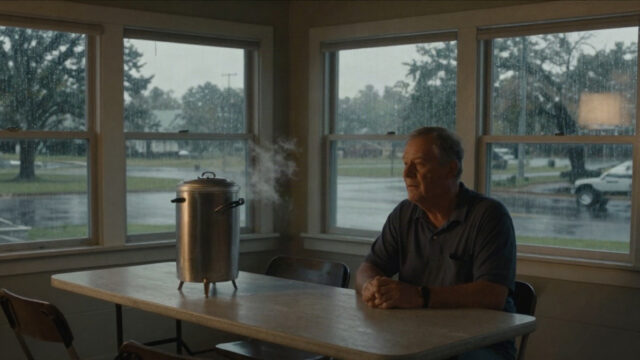
Samuel was there before anyone else, sweeping the floor. He had put a kettle on the old stove and set out cups.
Gregory arrived in his fleece vest with a leather folder under his arm. He was polite and a little nervous, the way men are when they realize they have walked into a family table.
I opened Walter’s ledger on the bench under the cupola window. The light came through the glass and fell across the pages.
“My father-in-law began this book in 1951,” I said. “He planted the sugarbush with his own hands, three hundred and ten trees by 1956. He kept a record of every one.”
I read it aloud, row by row. He planted for Lewis first, the big ones by the spring, in Row Seven, trees one through twelve. He planted for Dorothy in Row Four and for Patricia in Row Two. Each entry had a date, a number, and a few words in his careful hand.
Ruth Ann nodded slowly, the way she did when a story was starting to make sense.
Then I turned to the last pages and read the entry Walter had written in the spring of 1996, after Samuel came to the house.
“Row Nine, trees one through thirty, given to Samuel Whitehorse for his care of me and this farm. The tin note is his. The trees are his. Let no one take them from him.”
Samuel did not move. He sat on the end of the bench with his hands folded in his lap.
Gregory opened his folder and read the parcel list. His face changed as he read it. He looked up at Derek.
“The parcel list includes Row Nine,” he said. “Derek, did you check the planting records before you signed?”
Derek sat very still. Then he let out a breath and put his phone face down on the bench.
“No,” he said. “I didn’t. I never thought to look. I just wanted the money to fix the barn.”
Carrie put her hand over her mouth. Then she reached for her husband’s hand, and this time it was not to tell him what to do.
Gregory closed the folder. “Northline cannot take land it doesn’t own,” he said. “I’m withdrawing from the option. I’m sorry for the trouble, Mrs. Bramhall. I’d rather lose the deal than be part of a family quarrel that was never mine.”
I thanked him. He was a decent man who had been used by a bad plan, and I told him so.
After he left, we sat in the warm sugarhouse and talked it through. The family would form a land trust in the Bramhall name, with the whole sugarbush held in common. Carrie and Derek would be trustees alongside me. Samuel would be named caretaker for life, with a yearly share of the syrup and the right to live in the tenant house as long as he wanted.
Samuel said very little during all of this. When it was over, he stood and poured the last of the coffee into four chipped cups.
“Thank you, Mrs. Bramhall,” he said. “I never asked for any of this.”
“I know you didn’t,” I said. “That’s why it’s yours.”
The lease was withdrawn in November. The trust papers were signed in the county office in Barton that same month, with my name, Carrie’s, Derek’s, and Samuel’s on the deed.
In March 2027, the sap began to run. The cold nights and warm days came right on schedule, and the buckets filled on the south slope.
I walked the rows with Samuel in the early light, our boots squeaking on the wet snow. We stopped at Row Nine, where a big maple had split in the ice and then grown a new crown anyway.
Samuel knelt and set the spile in the bark with his thumb, the way he had done for thirty years. Then he stood, took the bucket from his shoulder, and handed it to me.
I hung it on the spile with my own hands. The first clear drop came down into the bucket with a small, bright tick.
There is a kind of truth that lives in paper, and a kind that lives in the people who have done the work every day for years. In our family, it had taken a storm, a ledger, and a quiet man to bring them together. I was glad we had found it in time.
This is a work of fiction. Names, characters, places and events are products of the author’s imagination; any resemblance to actual persons or events is purely coincidental. Images are illustrations.