The Chaplain Kept the Only Copy in a Gray Box. Then the Widow Admitted What She Had Signed
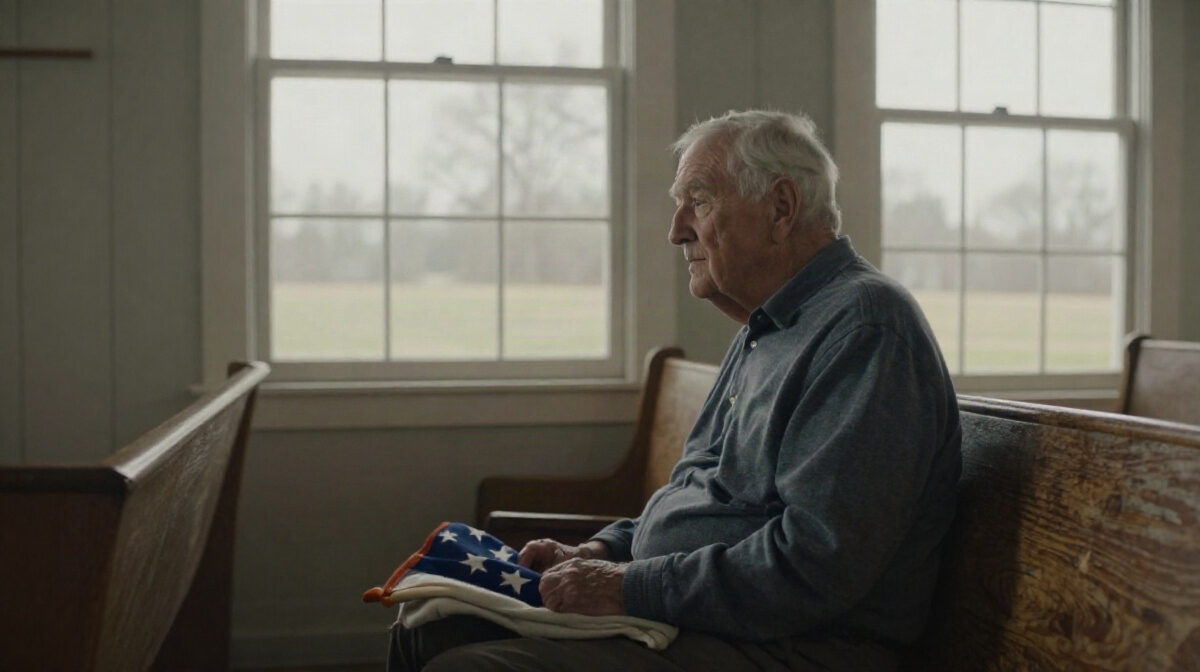
The flag was heavier than I expected. Somebody had folded it into a tight triangle, the way they do at every military funeral, and the blue corner was pressed flat against my palm. I held it on my knees in the third pew at Trinity Lutheran while the organ player finished the last hymn.
Gary Pfeifer leaned over before I could stand up. He smelled like coffee and cold air. “Harold, I need a minute with you after this. It’s about the place.”
“The place,” I said.
“The farm. Leonard’s farm.” He tapped the program in his hand. “It’s sold, Harold. Signed in the first week of January. Some outfit out of Hutchinson bought all six hundred and forty acres. The boy has to be out by spring.”
I looked toward the front of the church. Caleb Voss sat alone in the first pew, his big hands folded on his knees, his back straight as a fence post. He had not turned around once during the service. He did not need to. He had grown up on that land, and he knew every acre of it.
“Who signed for it?” I asked.
“Ruth did, with me there to help her. Leonard’s will left everything to her. Gary’s lawyer drew it up years ago. It’s all legal.” He shrugged the way a man does when he is sure of his paperwork. “Ruth wants to be near her daughter in Wichita. And the bank note is still about two hundred forty thousand. The place is worth over a million, but none of that does Ruth any good sitting in the ground.”
I did not say anything. My throat had gone tight, the way it did in the mess tent when a cook let the gravy scorch. I looked down at the flag and thought about Leonard Voss, who had never been a talker and had never once in my life said something he did not mean.
It was March of 1968. We were at the field hospital outside Pleiku, in a canvas ward that smelled of antiseptic and diesel and wet earth. I was twenty years old and assigned to the mess, but when the medics were short I carried stretchers. Leonard was a medic, a farm boy from Ellsworth County who never took his eyes off a patient longer than he had to.
That night a mortar round came in close. A piece of it caught Leonard in the side, not deep, but enough to bleed through his bandages. He lay on the cot beside mine with his face gone the color of paper. He was frightened, and I had never seen him frightened before.
“Harold,” he said. “If I don’t make it back, you see the farm goes to the boy. Caleb. Ruth and I are taking him in when I get home. I don’t want Gary anywhere near it.”
“You’re going to make it back,” I told him. “Quit talking.”
“Swear it.”
So I swore it. The next morning the chaplain, Emil Stroud, came through the ward with his little black notebook. Leonard asked him to write it down, and Stroud did, in his careful handwriting. I signed beneath it as a witness. Leonard did make it home. We both did. But I had never once in fifty-eight years looked at that paper again.
“Harold?” Gary said. “You hear me?”
“I hear you.”
“Good. Then you know there’s nothing to argue about. The papers are final.” He stood and buttoned his coat. “I’ll bring the rest of the paperwork by your house Tuesday.”
I stood up with the flag in both hands. My knees ached from the cold pew. I knew I had sworn to something in 1968, and I knew Leonard had made me promise it in front of a chaplain with a pen and a notebook.
But I did not have that note. I had not seen it since the morning it was written. I could remember the words only as a sound in my ears, and the sound was fading. Somewhere in Salina, in a care home room or a drawer, the only proof of Leonard’s wish was sitting where I could not reach it.