My Husband Gave Our Life Savings to His Brother. He Never Asked Me First
On the twelfth of October I baked a lemon pound cake, the kind Walter had liked since our first year of marriage. I set it in the middle of the table on my mother’s white cloth and pressed two candles into the top.
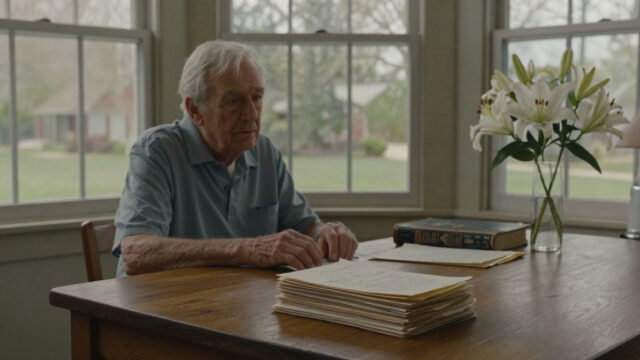
Then I laid out the papers beside it, one at a time: the bank statements, the loan agreement with our names on it, and Dwight’s foreclosure letter with its red stamp. I squared the edges with my fingers and waited.
Walter came in from the garage a little after six. He stopped in the doorway when he saw the table. I watched the color drain from his face, slowly, the way it does when a man realizes his day has finally caught up with him.
He pulled out his chair and sat down heavily. For a while he did not touch the papers. He only looked at the cake.
“Dwight came to my truck in January,” he said at last. “He was crying, Lorraine. He had the letters on the seat next to him. The bank was going to take the building, and his wife and the boys were going to lose the house too. He begged me.”
“So you signed it,” I said.
“I signed it in March.” He rubbed his face with both hands. “I told myself I could fix it before you ever saw a thing. I was going to pay it back. I didn’t want you to think I’d been a fool for my brother.”
“You were never a fool for helping him,” I said. “You were a fool for thinking you had to do it alone.”
He looked up at me then, and I saw how tired he was. I saw the boot in the back hall and the note he had written to himself. I saw forty years of him fixing other people’s wiring and never once asking anybody to fix his.
“Why didn’t you trust me with it?” I asked.
Walter opened his mouth, then closed it. He had no answer that made it better, and he knew it.
The back door opened. Renee came in first, her coat still on and her car keys in her fist. Dwight came in behind her, his cap in his hands. His eyes were red around the rims.
“Lorraine,” he said. “I should have told you myself. I hid it from my own family because I was ashamed. I’m sorry. For all of it.”
I nodded and let him stand there a moment longer. Then I told him to sit down.
Walter cleared his throat. He had written out a plan on the back of a parts receipt, the same kind of paper as the note. He read it slowly. He would repay the loan at $9,000 a month, starting in November, from his pension and the part-time electrical work he had already lined up. Dwight would sell his truck, put the money toward the debt, and work off his share at the restaurant until it was paid. And the lake house deed would be changed so it was in both our names.
“That way if anything happens to me,” Walter said, “you’re not left with nothing.”
I listened to all of it and did not interrupt. When he was finished, the kitchen was quiet except for the clock over the stove.
“I’ll sign the deed in the morning,” I said. “And I want you to promise me something. Never decide something this big alone again. Not for your brother, not for anybody. If we are going to lose something, we lose it together. If we are going to save something, we save it together.”
“I promise,” Walter said. His voice cracked on the last word.
Dwight wiped his eyes with his sleeve. Renee put her hand on my shoulder and left it there.
We lit the candles, and Walter cut the cake. It was a little crooked, the way his cuts always were. We ate it off our mother’s plates with the papers pushed to the side of the table, and for a few minutes nobody spoke at all.
Forty-one years is a long time to build something with another person. It is long enough to see them at their best and at their worst. What I learned that night is that trust is not the same as never being tested. It is what you decide to do after the test comes.
When I folded the loan papers into a neat stack, Walter reached across the table and took my hand. He did not say anything. He did not have to.
“Bring the deed to the credit union on Monday,” I told him. “With both our names printed side by side.”
This is a work of fiction. Names, characters, places and events are products of the author’s imagination; any resemblance to actual persons or events is purely coincidental. Images are illustrations.