My Son-in-Law Forged My Dead Husband’s Name on a Pawn Ticket. Then the Snow Brought the Truth Home
I did not answer him right away. I looked at Shane, a grown man in a canvas coat with his hands shaking, and I saw the boy with the bad haircut who had once eaten three helpings of my pot roast in one sitting. I saw the young husband who had promised my granddaughter he would take care of her.
“Because somebody forged my husband’s name on a pawn ticket,” I said. “And you know who signed it, Shane. So do I.”
Dustin started to say something, but Roger stepped between them. “Let her talk,” he said in the flat voice he must have used on a hundred frightened people at a hundred fires. “I have a 1979 crew roster in the truck. Want to see what it says about Charles Sandoval?”
The park was quiet except for the wind. A few porch lights came on along the row of trailers, and I saw curtains move. Phyllis came out of her double-wide in a housecoat and mismatched boots, and stood at the bottom of her steps with her arms crossed.
We all went into my kitchen, because it was warm and because it was mine. Kelsey put the kettle back on. Roger laid the roster on the table next to Charles’s citation, and his finger found the line without much searching. Charles W. Sandoval, Marine reservist, Yuma County volunteer assist, 1979. Two trapped men extracted from the third floor.
Then I opened the lining of the old service coat that hung on the back of the kitchen door. Charles had sewn a small pocket inside the left side, with thick cream thread that had gone brittle with the years. I had never known it was there. I found it only when I went to mend a tear the week after his funeral.
Inside lay an envelope in his careful capitals. It was dated October 1998, and the flap was sealed. Written across the front in the same square letters was my name: WANDA.
My hands were not quite steady as I broke the seal. Kelsey came around the table and stood beside me. Roger sat down slowly, and Shane stood in the doorway with his cap in both hands and did not speak.
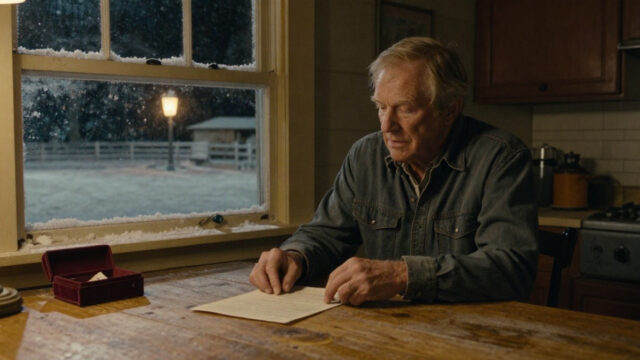
I read it aloud, because Charles would have wanted the words said out loud in a room where people could hear them.
“Wanda,” the letter began. “If you are reading this, I am gone, and you have found the box in the closet. I want you to know what happened in 1979, because I never told you the whole of it. The grain elevator was burning, and two boys from the volunteer crew were on the third floor, and nobody could reach them. I went in because it was my job to try. I did not think about medals. I thought about those boys’ mothers.”
Kelsey was crying quietly. Roger stared at the table. I went on.
“The medal is not a ticket to anything, love. It is a reminder of two lives that were saved and the men who came home to their families. Do not let anybody sell it to pay a debt. Keep it with the people who kept faith with me, the ones who came to see me when I was sick and the ones who loved me without asking what I had done. That is you and Kelsey, and whoever you choose to share the table with. I love you. Charles.”
When I finished, the kitchen was silent except for the kettle beginning to sing. Roger looked up first. “Shane,” he said, “did you forge that pawn ticket?”
Shane’s face crumpled. He looked at Kelsey, then at me, and the cap slipped from his fingers and dropped onto the linoleum. “I didn’t have a choice,” he said hoarsely. “The bank was going to take the house and the trucks. Dustin said the medal was worth enough to cover it, and Charles wouldn’t mind. I thought nobody would ever check.”
“Charles would have minded very much,” I said quietly. “He would have given you the shirt off his back if you had asked him straight. He would never have let you sell his honor behind his wife’s back.”
Dustin shoved past the doorframe into the room, red-faced and angry. “This is ridiculous. It’s a piece of metal.”
Kelsey stood up then. She was thirty-six years old, and she looked, for the first time in a long while, like her grandfather’s granddaughter. “It is not just metal,” she said. “It’s my grandfather’s life, and it stays in this house. Shane, you should have come to me. You should never have lied to my grandmother. And you’re not taking another thing from her.”
Dustin looked at Phyllis, who had come up behind him at the door, and for once in her life she had nothing to say. He took the torn pawn ticket Roger held out, read it once, then crumpled it in his fist. “Fine,” he muttered. “Keep your junk.” He turned and walked out into the snow, and Phyllis followed without a word.
Shane sat down heavily at the table, his face in his hands. Kelsey put a hand on his shoulder, not unkindly, and told him they would find a way through the debt together, with the bank and with the family. It would not be easy, but it would be honest.
I walked down the hall alone to the bedroom and lifted the cedar box from the closet shelf. I set Charles’s citation inside. Then, from the pocket of his old coat, which I had carried back with me, I took the Bronze Star. Its ribbon was faded blue, its bronze face cold from the snow outside. I laid it in the box beside the citation and closed the lid gently.
When I came back into the kitchen, the kettle had long since gone quiet. Roger had poured himself a cup of tea and was sitting with Kelsey at the table, and Shane was staring at the letter in his lap. The window glowed with snow, and every flake drifting past it caught the lamplight.
We stayed up the rest of the night in that warm kitchen, eating the leftover ham and cornbread and telling Charles stories. Roger told us about the Yuma fire and the two young men who had lived to raise families of their own. Kelsey told us about the summers she spent in the hay barn with her grandfather, learning to drive the old tractor. Shane said very little, but he stayed.
The Bronze Star sat in its cedar box in my closet that night, right where Charles had always meant it to be. I went to bed late, and for the first time since March of 2024, I slept through till morning. Outside, the snow kept falling on the trailer park, softening every road and roof until the whole place looked like it had been wrapped for a gift. It was a long way from the hay fields Charles and I had worked together, but it felt like home all the same.
This is a work of fiction. Names, characters, places and events are products of the author’s imagination; any resemblance to actual persons or events is purely coincidental. Images are illustrations.