The Chaplain Kept the Only Copy in a Gray Box. Then the Widow Admitted What She Had Signed
I did not raise my voice. I have stood in front of a steam table for thirty-one years, and I learned that people listen best when you speak plainly. I walked to the front of the room and held up the yellow sheet so everyone could see the ink.
“Gary,” I said, “before you bring out the papers, I want to read something. It’s from March fourteenth, 1968, a field hospital north of Pleiku. Leonard Voss dictated it, and Chaplain Emil Stroud wrote it down. I signed it as the witness.”
A murmur went around the room. Pastor Hruska leaned forward with her glasses in her hand and said nothing. I cleared my throat and read it aloud, the same words the chaplain had read to me in his recliner in Salina.
“If I do not return, my farm in Ellsworth County is to pass to the boy Caleb Voss, whom Ruth and I will adopt upon my return home. This is my wish. I have made it freely.”
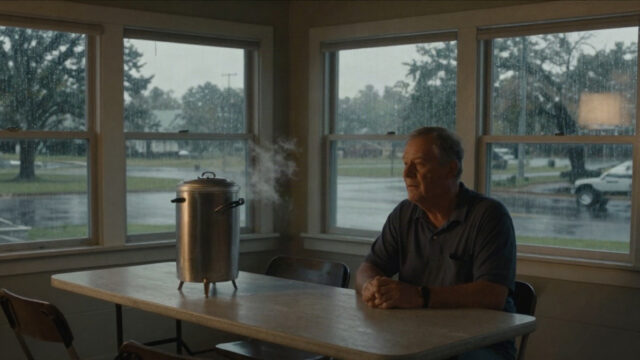
When I finished, the room was silent except for the buzz of the coffee urn. Gary’s face had gone red above his collar.
“That’s an old scrap of paper,” he said. “A dying man’s wish, in a war. Lawyers don’t—”
“It’s a sworn statement,” Pastor Hruska said quietly. She held out her hand for the sheet, and I gave it to her. She read it twice, then looked over the top of her glasses at Ruth. “Ruth, is this what I think it is?”
Ruth set her cup down. Her hands were trembling, and she laced her fingers together to hide it. For a long moment she said nothing. Then she spoke in a voice so small I almost missed it.
“I signed an agreement in 2011,” she said. “Leonard and I both did. It named Caleb as the heir. It was at the bank in Ellsworth, in the lockbox. Gary was there that day.”
Gary’s chair scraped back. “Ruth, you know that’s not—”
“Then in 2012 Gary brought a lawyer out to the house,” Ruth went on, not looking at him. “He said the bank would want a newer will on file, that the old papers were a mess. He said it was just a formality. I signed the new one at the kitchen table without reading it. Leonard was out in the barn, and I didn’t want to bother him.” She lifted her eyes at last, and they were wet. “I never thought about it again until Leonard died. I told myself it didn’t matter, because Leonard would have taken care of Caleb. Then Gary said the place was sold, and I didn’t know what to do.”
Caleb stood up in the back of the room. He did not come forward. He only looked at his aunt, and his face was hard and quiet. “You knew,” he said. “You could have said something.”
“I know,” Ruth said. “I’m saying it now.”
Pastor Hruska stood. “I’ll call Dwight Brandt at the county recorder’s office in the morning,” she said. “He keeps every filing in that county, including the old agreements. If the 2011 paper is there, we’ll see it.”
Gary sat down heavily. He did not argue anymore. He only opened his folder and stared at the papers as if they had turned to ash.
The county recorder called on Monday. The 2011 agreement was on file, signed by Leonard and Ruth Voss, naming Caleb Voss as sole heir to the Ellsworth County property. The sale papers were withdrawn by Wednesday. Gary Pfeifer drove out to the farm that Friday, stood in the yard with his hat in his hands, and apologized to Caleb for the first time in his life. Ruth moved her things into the farmhouse that same week and said she would stay as long as the boy would have her.
In October the wheat went in. The sky was clear and cold, and the ground smelled of turned earth and the last of the summer dust. Caleb drove the planter, and I rode beside him on the old Ford tractor with a thermos of coffee between my boots, the way I had ridden beside his father in another life. We went up and down the rows all afternoon, and nobody said much. None of us needed to.
When the last pass was done, I climbed down and walked to the truck where I had left the flag in its triangle of blue. I carried it out to the field and held it out to Caleb. He looked at it a long time before he took it.
“He’d want you to have it,” I said. “He was proud of you. He just never could say it right.”
Caleb tucked the flag under his arm and looked out over the rows of green shoots coming up through the dark soil. He did not say anything, but he nodded once, slowly, and I knew he understood.
A man keeps his word even when the paper is gone, I think. I had carried mine for fifty-eight years without ever once looking at it. The chaplain had kept his in a gray box, and Ruth had kept hers in a guilt she could not put down. In the end it was the plain promise of a dying friend, written down by a careful man and remembered by a cook, that brought the farm back home to the boy who had earned it.
This is a work of fiction. Names, characters, places and events are products of the author’s imagination; any resemblance to actual persons or events is purely coincidental. Images are illustrations.