The Church Women Turned a Hungry Boy Away in 1991. Thirty-Six Years Later, One Note Changed Everything
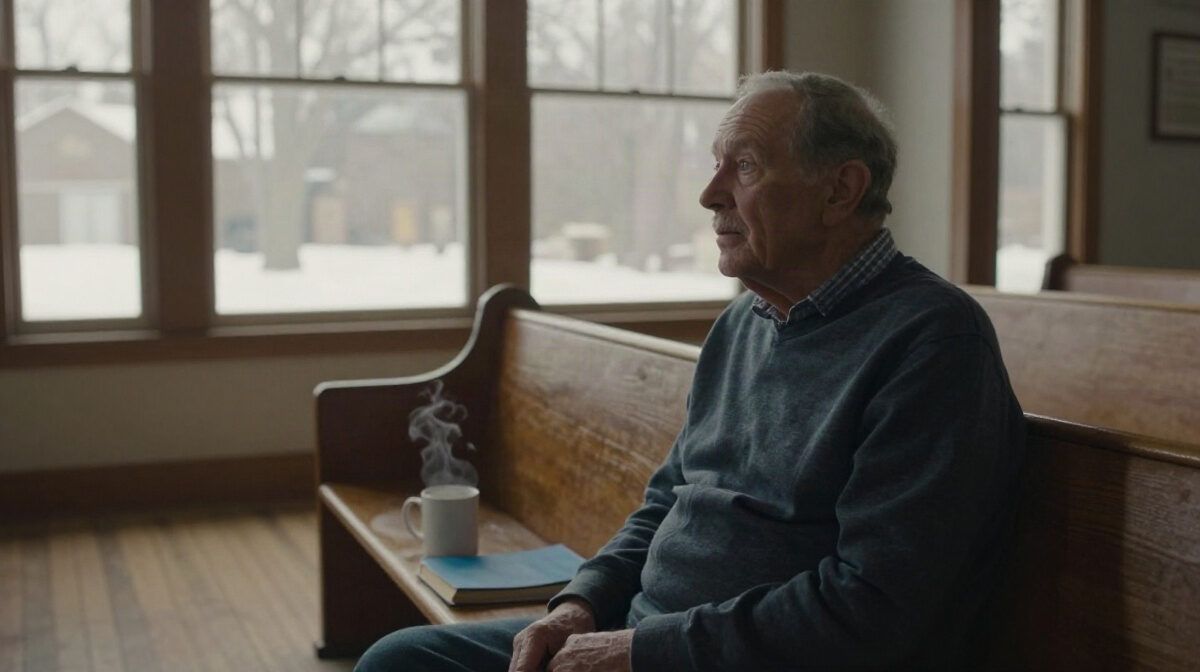
The man in the back pew did not look like he belonged in a church, and he knew it. I could see that from the basement kitchen window, where I stood with a wooden spoon in one hand and a dish towel in the other. He sat with his coat still buttoned and his hands folded on his knees. Every few seconds, one of them began to shake.
I had asked Bev to take over the stockpot. She was happy to, since she was the one who had first given me the news that morning. “Teresa, you’re going to make the soup for Dale Wiese,” she had said, shaking her head. “Marjorie already asked everybody else. Nobody will touch it.”
I knew why. Dale Wiese had been a grain hauler and a county commissioner, and he had been cold to almost everyone in Harlan Ridge for as long as anyone could remember. He had sued a widow over a fence line in 2009 and won. He had called the sheriff on a boy who was only hunting pheasant on land he thought was empty. People did not cry at his funerals. They came because it was expected.
I said yes to Marjorie anyway. I have sat with a lot of unloved men in their last weeks, and most of them were scared underneath the gruffness. Soup seemed like a small thing to give.
So on Saturday morning, February 13, 2027, Bev and I started the Lenten soup at seven. It is a potato and ham soup with barley, the kind my mother made on the farm outside town when the wheat was poor and the meat was thin. We filled the 40-quart stockpot halfway with water, added the ham bone, and let it simmer while we cut the potatoes into small cubes. The kitchen smelled like smoke and onion and something sweet. Bev hummed hymns off-key the whole time.
At 10:40, the back door opened. A thin man in a brown canvas coat stepped in, with snow on his shoulders and his hat in both hands. He looked at the stockpot, then at me, then at the floor.
“Excuse me,” he said. “Is this the church for the Wiese funeral?”
“It is, honey,” Bev said. “Come on in out of the cold.”
“Yes, ma’am. Thank you.” He said it three times before he stopped.
I poured him a cup of coffee in a white mug and set it on the counter. He wrapped both hands around it and did not drink. His name, he said, was Lonnie Strahan. He had driven down from Grand Island that morning in his old pickup because he had worked with Dale Wiese’s son once, a long time ago. He did not say more than that, and I did not ask.
Upstairs, the organ started its soft warm-up. Through the ceiling I heard feet moving across the wooden floor and the squeak of the front doors. Then the sound changed, the way a room changes when people stop talking all at once.
Marjorie Heilman came down the basement stairs with her good wool coat still on and her purse over her arm. She was seventy-four and had run the Altar and Rosary Society for twenty years, and she had a way of standing that made people straighten. She did not come to the kitchen door. She stopped at the bottom of the steps and looked through the small window at the back pew, where Lonnie Strahan sat with his mug between his knees.
She looked for a long time. Then she turned to me, and her face was pale.
“Teresa,” she said quietly, “do you know who that is?”
“No,” I said. “I just met him. He’s here for the funeral.”
“Yes you do,” Marjorie said. “It’s the Strahan boy from the home.” She turned back toward the stairs without another word.