The Church Women Turned a Hungry Boy Away in 1991. Thirty-Six Years Later, One Note Changed Everything
I did not give Marjorie the paper. I stepped out from the side aisle, walked past the front pews to the sanctuary steps, and stood beside the altar with the folded note in my hand. My knees were not steady, but I have stood up in a lot of rooms where I did not want to be, and my voice has always known what to do.
“Before Mass goes on,” I said, “I need to read something that was left in a hymnal in this church.”
The silence was complete. Even the candles seemed to stop flickering.
I read it aloud the way I would read a patient’s chart to the family. I said the three names slowly: the Heilmans, the Kallenbachs, the Hofstetters. I said the year, 1991. I told them about the Christmas meal and the basket of food that was meant for families. I said that a six-year-old boy from St. Brendan’s Home had walked up to the church door in the snow, and that three grown women and one grown man had told him the basket was not for him. Then I read the last line. They sent him out into the snow.
Nobody coughed. Nobody shifted. Somewhere in the basement, I could faintly hear the stockpot bubbling.
Cal Hofstetter stood up. His face was red from his collar to his hairline. “That was a different time,” he said loudly. “My dad ran the elevator. We didn’t have room for every kid in the county.”
“No,” said Doris Kallenbach.
Her voice was thin, but it carried. She stood up slowly in the third row, one hand on the back of the pew, and looked straight at the back of the church. Her hands were shaking.
“I wrote that note,” she said. “Years ago. I was there that night and I knew what we had done, and I was too much of a coward to say it out loud in this church. So I wrote it down and gave it to Walt, and told him to keep it in a hymnal until the boy came back. I didn’t think he ever would.”
She turned her wet eyes to the last pew. “Lonnie. Honey. Would you come sit with me?”
Marjorie drew in a sharp breath and did not look up. Her face was set like stone, but her fingers were twisting the strap of her purse.
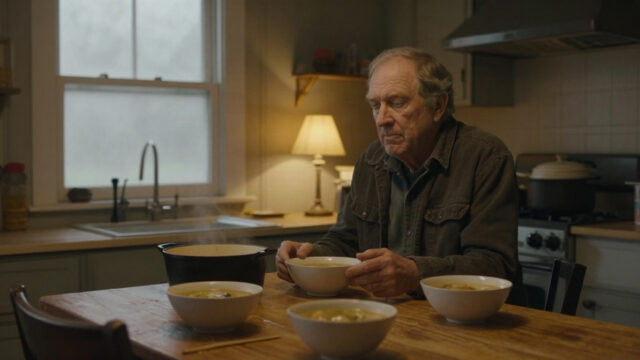
I did not wait for anyone to argue. I asked the congregation to make the repair plainly, the way you would put a bandage on a cut, without fuss. I asked that Lonnie Strahan be given a seat in the front pew for the Mass. I asked that the Altar Society invite him to the Lenten supper after the burial, and that a bowl of soup be set in front of him, the same soup that had been made for Dale Wiese, the same soup no one had wanted to make.
Russell Pohlman left his post by the door without a word. He walked down the center aisle, past the front pews, to the last bench at the back. He stood beside Lonnie and said something too quiet for me to hear. Lonnie stood up, shaking so hard that his hat fell to the floor. Russell picked it up, handed it back to him, and walked him forward one slow step at a time.
Doris reached out her arm as they came near. Lonnie took her hand. Then he sat down in the third row beside her, and she held onto him like a woman holding a child on a windy day.
Bev Lindgren came up from the basement with a bowl of Lenten soup in both hands, steam rising off the top. She walked straight up to the front pew and set it on the edge of the wood in front of him. “Eat that,” she said bluntly. “It’s good. We made it for the funeral, but there’s plenty.”
At communion, Lonnie Strahan knelt at the rail. Russell stood close by him. One by one, the Heilmans came up the aisle. Then the Kallenbachs. Then the Hofstetters, Cal last and very red in the face. Each of them knelt beside Lonnie at the rail, and none of them said anything, and none of them needed to.
Lonnie took the bowl of soup from Bev’s hands after Mass. He looked up at me with his eyes wet and his mouth trembling. “I was only ever hungry,” he whispered.
The whole church was quiet, except for the sound of Doris Kallenbach crying in the front pew.
I sat down beside Lonnie in the front row that afternoon, and I did not get up for the burial. I had sat beside a lot of people at the end of their lives, but I had not sat beside anyone at the start of a new one in a long time. Gene would have liked that. Dale Wiese would not have cared. The soup, I think, would have been enough for both of them.
A church is only a building until someone decides who belongs in it. That February, the people of St. Brigid’s finally decided, and I was proud to be standing in the middle of it when they did.
This is a work of fiction. Names, characters, places and events are products of the author’s imagination; any resemblance to actual persons or events is purely coincidental. Images are illustrations.