The Developer Said Our Family Graves Were Unclaimed. A Widow’s Dog Knew Better
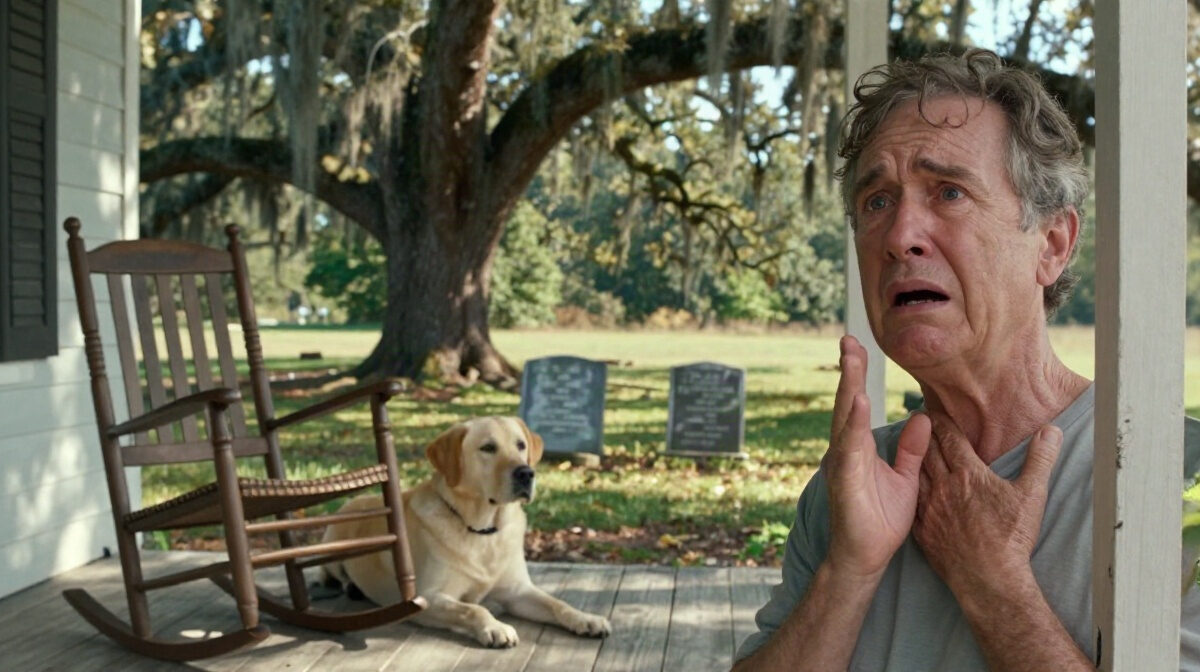
The water came up over the porch steps a little after midnight on March 14, 2026. I heard it before I saw it, a low hush against the boards. Then Gumbo started barking like he had a grudge against the whole river.
He is twelve now, and his hips are slow. But he planted himself on the top step with his legs stiff and his tail straight out, and he would not budge. I called him in the voice Ray always used, the one that never failed. Gumbo just looked at the water and barked again.
“Come on, boy,” I said. “It’s only rain on the snow up north. It’ll go down by morning.”
He did not come. He backed up a half step and pushed his nose at the floorboards by the door, the old loose one near the rosebush. Then he looked at me and whined.
I went inside for a towel and the big flashlight from the hall closet. The house smelled of coffee and cold cedar. I got down on my knees on the wet porch, and Gumbo came to my side at last and lay down over the board, the way a dog lies on a rug he means to keep.
Ray built this house on Rue des Ormes in 1989, with his own two hands and a lot of help from his brothers. He always told me not to step on the third board from the door. It rocked, he said, and he meant to fix it someday. He never did.
I worked the board loose with a butter knife. Underneath, in the dark dirt and damp sawdust, sat a gray metal tin about the size of a loaf of bread. Someone had wrapped it in oilcloth and tied the cloth shut with twine.
Gumbo sighed and put his chin on his paws. I had the strangest feeling that he had been waiting on me for a long time.
I carried the tin inside and set it on the kitchen table under the light. Water dripped off my knees onto the linoleum. My hands were steady, which surprised me. Ray had always said I was the calm one.
The oilcloth came away easy. Inside was a folded letter in Ray’s square handwriting, sealed with a notary’s stamp. Beneath it lay a stack of yellowed papers held together with a rubber band gone brittle as a leaf.
I read Ray’s letter first, because I knew his hand better than anyone’s. Then I unfolded the papers, and the first line on the top sheet made my stomach drop cold.
It was a copy of a deed, recorded in 1902, and it said plainly that the cemetery parcel behind our house was already owned by Teche Ridge.