The Developer Said Our Family Graves Were Unclaimed. A Widow’s Dog Knew Better
On October 6, the St. Martin Parish Council chambers were full. The air was cool and smelled of floor wax and old wood. I wore my good navy dress and my grandmother’s pearl earrings, and I carried the tin under one arm.
Father Mouton sat with me in the front row. Before the meeting started, he took my hands and prayed in a low voice, and I felt steady for the first time in weeks.
Winston Abshire stood up first. He wore a gray suit and spoke smoothly, the way men do when they have said the same words many times. He told the council that the deed in our hands was only a copy, that the original could not be found, and that Teche Ridge had every right to clear land no one had claimed in over a century.
Then I stood. My knees were shaking under the table, but my voice held.
I opened the tin and laid the papers out. I read the burial ledger aloud, one name after another, slowly, the way my grandmother taught me to say the rosary. Octave Broussard. Marie Broussard. Little Pierre, who was four years old and died in 1866 of the fever. I read all nineteen. The room was so quiet I could hear the clock on the wall.
When I finished, Bobby-Joe Landry stood up from the back row. He walked up the aisle slowly with his hands in his pockets and stopped beside my chair.
“I need to say something,” he said, his voice shaking a little. “Years ago, when the courthouse files were moved to the new records room, I misfiled the original 1902 deed under the wrong parcel number. I did not mean it. But I did it, and I never told anyone. Ray found out. His letter in that tin names me as the witness who must set it right, and he was right to name me.”
A murmur went through the chambers. Winston Abshire opened his mouth to speak, then closed it again.
The council chairman, a tall man named Dupuis with silver hair, asked to see the letter. Ray’s notarized statement said that in 2019 he had signed a burial-rights agreement with the parish to protect the Broussard plot as a family cemetery, and that Bobby-Joe had witnessed it. The notary’s stamp was still crisp and clear on the page.
The council went into a short recess. When they came back, Chairman Dupuis read the vote. The plot would be protected as a historic family cemetery, and no clearing work would proceed on the parcel.
Hollis Guidry had been sitting in the third row the whole time with his cap in his hands. When the vote was read, he stood and walked over to me. He did not say anything at first. He only nodded.
“I’ll call my company tonight,” he said quietly. “The work is off. I’m sorry for the trouble I was part of, ma’am.”
“Thank you, Hollis,” I said. “You did what you were told. I know that. You are a decent man.”
Jolene drove up from Lafayette that week, and this time she stayed for supper. She sat in my kitchen and looked at the old papers and the tin. She told me she would come out every other weekend. She said she did not like the idea of me alone on the bayou, but she understood now why the land mattered. I told her I was glad.
That evening I walked out to the back lot with Gumbo at my side. The stones stood in their rows under the live oaks, the names still legible, the chrysanthemums I had planted in the spring nodding in the wind. The bulldozers were gone. The gate was closed.
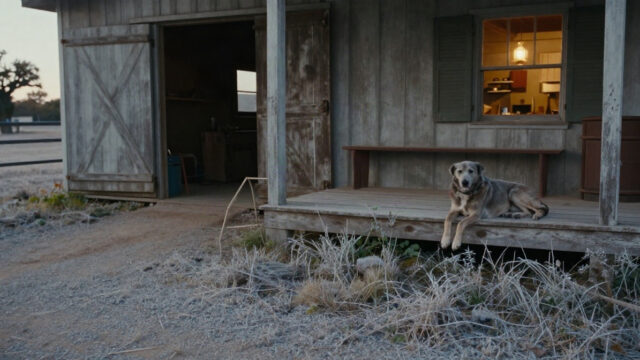
Gumbo went back to the front porch, climbed the steps one at a time, and settled himself at the top with his nose on his paws, looking out toward the graves the way he had since the spring Ray buried the tin. I sat down beside him in Ray’s old rocker.
The river had gone back down to its banks long ago. The frogs were starting up in the ditch. My family rests where it has always rested, in the ground Ray built his house beside, and I think they are glad of it.
Gumbo sighed and leaned his warm weight against my leg. I rested my hand on his head and kept watch with him.
This is a work of fiction. Names, characters, places and events are products of the author’s imagination; any resemblance to actual persons or events is purely coincidental. Images are illustrations.