The Handwritten Will Hidden in a Cookbook: How a 59-Year-Old Father Kept His Neighbors’ Home on New Year’s Eve
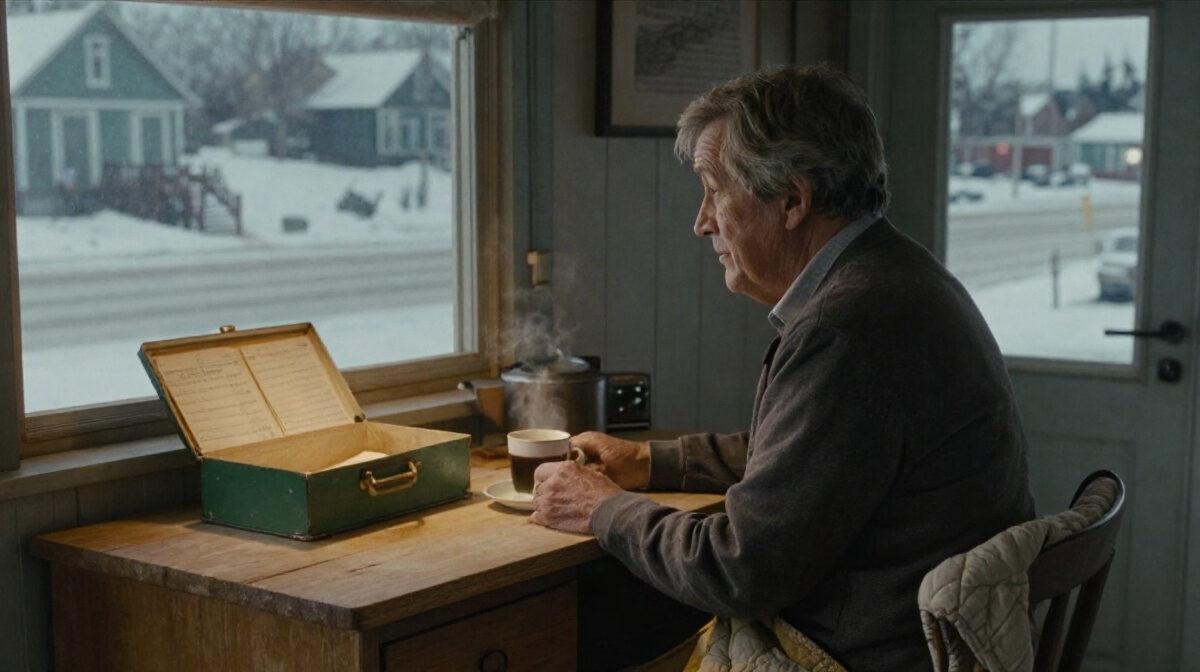
The harbor smelled of diesel and cold salt when Eugene Dunleavy walked up to my net shop with a folder under his arm. It was the first Thursday of October, 2026, and the wind was pushing gray clouds across Port Calder like a broom.
“You’re Floyd Sandoval,” he said. It wasn’t a question. He didn’t offer his hand.
“That’s right,” I said. I kept my eyes on the net I was mending. Tyler was across the shop splicing line, and he stopped working to listen.
Eugene was fifty-two, born in 1974, according to the paper he waved at me. He had his aunt’s chin and none of her patience. He wore a good coat that didn’t fit him right. It was the kind of coat a man buys when he wants people to think he’s doing better than he is.
“My aunt Constance is not fit to manage her affairs anymore,” he said. “I have papers that say so. The house on Pier Street needs to be sold before the new year. I’m her only family.”
I set down the needle. Constance Haskins was eighty-one years old. Her husband Herbert had been my closest friend for twenty years, and he had died in March of 2024. Since then, Constance had sat at her kitchen window every morning, watching the boats go out.
“She’s got her mind,” I said. “I talk with her every day.”
“Then she won’t mind signing,” Eugene said. He opened the folder and held up a page with a lot of printed words and a line for a signature. “The house is valued at two hundred ten thousand dollars. She has about sixty-four thousand in savings and her pension. That’s not enough to live on in a place with a winter like this.”
I figured those numbers were probably right. Herbert had talked about money the way other men talked about weather, plainly and without fuss. He had told me once that he and Constance had put every dollar they had into keeping that house paid off.
“Her house isn’t yours to sell,” I said.
Eugene gave a short laugh. “It’s going to be mine when she’s gone, and she’s going to be gone sooner than you think. I’m trying to get it done properly.”
Tyler set down his spool. “That’s a cold thing to say about your own aunt,” he said.
Eugene looked at him, then back at me. “Mind your boy, Floyd. This isn’t your business.”
“Constance is my business,” I said. “She’s been my business since 2004, when Carol and I moved in next door. Herbert taught me to mend nets in that backyard shed. After Carol got sick, Constance brought a casserole over every night for a month.”
I didn’t say the rest. Carol had died in 2014 of an illness that moved faster than any of us wanted. Constance had sat with my daughter Jessica through the long nights, and she had never once asked for a thank-you.
Eugene shut the folder. “You’ve got one month. I want the house cleared of her things by December thirty-first. The sale date is set. If she won’t sign, the county will handle it.”
He turned to go. The gulls screamed over the pilings, and a wet rope slapped the dock.
Across the street, in the window of the Haskins house, a small figure stood with one hand on the glass. It was Constance. She wasn’t crying. She was looking straight at me with a calm I didn’t understand.
I walked over that evening with a loaf of bread from the bakery on Water Street, the way I had every Thursday for twenty years. Constance let me in, leaned on her cane, and went to the kitchen table without a word.
“Eugene came to see you today,” she said.
“He did.”
“He thinks I’ve gone soft.” She poured two cups of coffee with a hand that shook only a little. “I haven’t gone soft, Floyd. I have made my arrangements.”
“What arrangements?”
She smiled, but she only looked at the window. “The ones that matter,” she said softly. “Don’t you worry about them. Just keep an eye on that man for me.”