The Handwritten Will Hidden in a Cookbook: How a 59-Year-Old Father Kept His Neighbors’ Home on New Year’s Eve
By New Year’s Eve the snow had come down off the Coast Range and lay thin and gray along Pier Street. The sky was clear and cold, and the lights in the village windows made long yellow squares on the wet road.
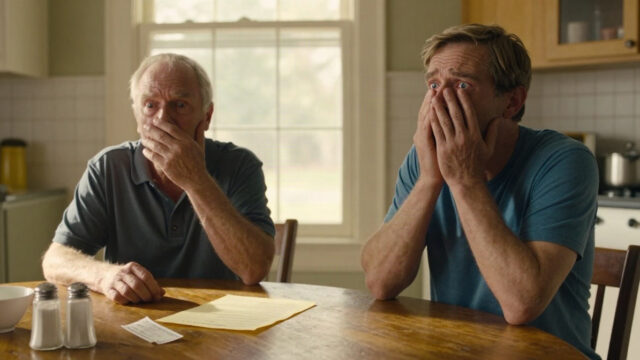
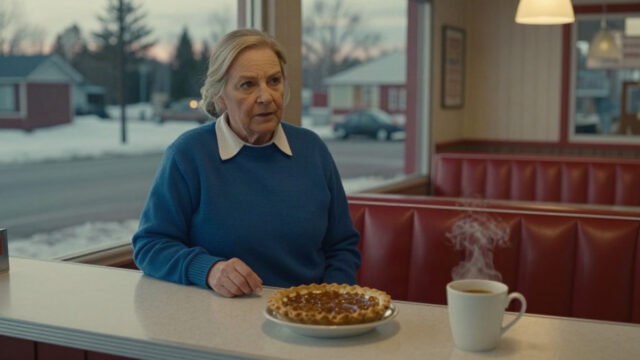
Eugene had asked for the meeting. He sat at the Haskins kitchen table in his good coat with the folder at his elbow. Across from him sat Constance, wrapped in her blue cardigan. Beside her, Jessica held a cup of tea she wasn’t drinking. I stood by the stove. Tyler leaned in the doorway.
The village had come too. Justin Hale, the notary from the post office annex, sat quietly at the far end of the table with his briefcase open. Old Mrs. Orr from the bakery, the harbormaster, and two men from the net co-op stood in the front room and waited. Nobody spoke much.
“This is a family matter,” Eugene said, looking around at the crowd. “I don’t see why the whole town needs to be here.”
“Because it’s their business too,” Constance said. Her voice was thin but steady. “Herbert and I lived here for fifty years. These people have carried our groceries, mended our fences and sat up with us when we were sick. They have earned the right to watch.”
Eugene’s jaw tightened. He opened the folder and laid a document on the table. “This is the will my aunt made in 2019. It names me sole heir. It’s valid. It’s been on file in the county office for years.”
Justin Hale leaned forward and studied it. “I can see the signature is genuine,” he said. “But I can also see that the date is seven years old.”
“It was the last will she wrote,” Eugene said.
“Not quite,” Constance said.
She turned her head toward the stove. “Floyd, bring me the recipe box, please.”
I brought it over and set it in front of her. The green paint had worn away at the corners. Constance put her thin hand on the lid and didn’t open it.
“I took something out of this box last spring,” she said to Eugene. “And I put something back. You never looked here, because you never cooked a meal in my kitchen.”
She lifted the lid. Her fingers moved through the cards until she came to the bottom, where the wood showed a thin slot. Then she bent with a small wince and drew out a white card with a folded corner. Inside it, folded twice, was a letter written in blue ink on lined paper.
Jessica took it gently from her and unfolded it on the table. Constance nodded. “Read it, please, Justin.”
Justin Hale put on his reading glasses. He looked at the top of the page and then the date at the bottom. “It is dated May 2024,” he said. “Two months after Herbert died. It is in Constance Haskins’s handwriting.”
He turned to the last page. “It is witnessed by two people. One is Floyd Sandoval. The other is myself.”
Floyd and Justin were the only two men in the room who could say that. I remembered the afternoon. Constance had asked me to sit with her at the kitchen table, and Justin had come up the hill with his stamp and his pen. She had signed in front of us both with a steady hand. Then she had asked me to keep her secret.
Justin cleared his throat. “I, Constance Haskins, being of sound mind, leave my house on Pier Street and all that is in it to the family of Floyd and Carol Sandoval, who gave me care, company and kindness through the years. To Jessica Sandoval, who sat with me in the night, I leave my husband’s fishing knife. To Tyler Sandoval, who carried my groceries, I leave the quilt my mother made. To Eugene Dunleavy, I leave my love and my prayers, and my savings of sixty-four thousand dollars, which I ask him to use wisely.”
The room went quiet. Mrs. Orr put her hand over her mouth.
Eugene’s face went pale. He looked at the will, then at his aunt, then at the folder that now seemed very thin on the table. “That isn’t fair,” he said, but his voice had lost its edge.
Justin Hale looked up over his glasses. “Mr. Dunleavy,” he said, “this document has been witnessed and notarized. I will file it with the county clerk tomorrow morning, and I expect the clerk will recognize it.”
This is a work of fiction. Names, characters, places and events are products of the author’s imagination; any resemblance to actual persons or events is purely coincidental. Images are illustrations.