A Stray Cat Kept Visiting a 91-Year-Old Woman’s Room. Nobody Asked Why Until New Year’s Eve
Ruth gave me the sealed letter the next afternoon. She lifted it from the bottom of the biscuit tin, wrapped in a square of yellowed tissue paper, and placed it in my hands as if it might break.
The envelope was cream-colored, with Helen’s careful handwriting across the front. It said only: For Margaret, to be opened when the time comes.
I drove home with it on the passenger seat, and I did not turn on the radio. At the kitchen table I slid a butter knife under the flap, very slowly, the way Frank used to open his mail.
The letter was one page, dated June 9, 2009. Helen had written in blue ink, neat and proud, the way she did everything.
“My dear Margaret,” it began. “I am writing this so there can be no question later. The house on Pine Street has been in this family since 1931, and I want it to stay with you for as long as you live. I know Daniel loves you, and I know he has his father’s restless heart. Please do not let the house be sold while you are living there. It belongs to the woman who has kept it warm for us all. With all my love, Helen Ellison.”
Below her name was a second signature, shakier and smaller. It read Walt Dorsey, witness.
I read it three times. Then I put my head down on the table and cried for a good while, the way I had not cried since the day we buried Frank.
The next morning I drove to the county clerk’s office in Ouray, where a notary named Linda Cruz watched Walt’s statement get signed. Walt was too weak to come himself, so he had sent it with his grandson. Linda pressed her seal onto the paper with a firm, satisfied thump. “That’s a good letter,” she said. “Helen knew what she was doing.”
On December thirty-first, the sky was pale and cold, and a thin layer of snow covered the porch swing. Daniel pulled into the driveway at ten o’clock with the realtor in the passenger seat. He had a folder under his arm and a look on his face like a man walking to the gallows.
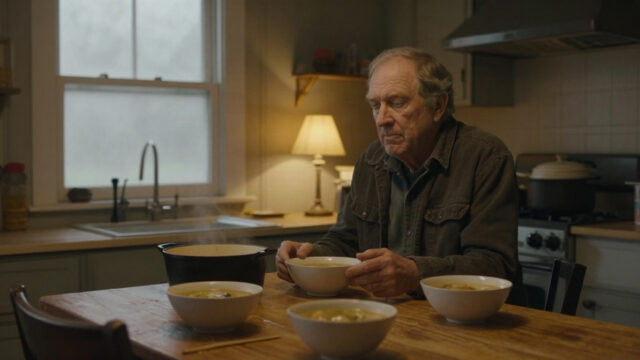
I met them at the door with a pot of coffee. “Come sit at the kitchen table,” I said. “Everybody. There’s something I need to read to you.”
The realtor looked at Daniel, and Daniel looked at me. For a moment I thought he might refuse. Then he sat down.
I laid Helen’s letter on the table, smoothed it flat with my hand, and read it aloud. I read every word in my steadiest voice, the one I used on the hospital ward in 1979 when a boy from Kansas was afraid to be moved. When I got to the line about the house belonging to the woman who had kept it warm, my voice wavered, but I did not stop.
When I finished, the kitchen was silent except for the radiator knocking. Daniel stared at the paper for a long time.
Then he put his face in his hands. His shoulders shook, and I realized he was crying too.
“I was scared, Mom,” he said through his fingers. “The restaurant is gone. The bank is calling every week. I thought if I could just sell the house, everything would be fine, and you’d be safe, and I wouldn’t have to tell you how bad it got.”
I reached across the table and held his hand. It was the same hand I had held when he learned to ride a bicycle in the alley behind this house.
“You should have told me,” I said. “I would have helped.”
He lifted his head, and his eyes were red. “Would you help me set up a payment plan? I don’t want to lose the house, Mom. I just want to stay close enough to take care of you.”
I looked at my son for a long moment. Then I looked at the letter, at the photograph of Frank on the windowsill, and at the green porch swing outside the window.
“Yes,” I said. “We’ll figure it out together.”
The realtor gathered her papers without a word and wished us a happy New Year on her way out. That afternoon I called her office from the kitchen phone and canceled the buyer’s contract. I did not feel one ounce of regret.
The next morning Daniel and I drove to Aspen Ridge with a small carton of heavy cream and a saucer. We went up the porch steps together, and Biscuit was already waiting on the top step, gray and dignified, as if he had been expecting us all along.
Daniel poured the cream into the saucer, and the cat drank it slowly. Through the window of Room 14, Ruth sat propped on her pillows, watching us. She smiled the way Helen used to smile when a thing had gone right.
Sometimes I think about how close we came to losing that house. Helen, Ruth, and Walt kept their promises quietly, for years, in a biscuit tin and a stubborn old heart. And I think about how a plain gray cat, with nothing to prove, walked into a room and showed me where I was supposed to be.
This is a work of fiction. Names, characters, places and events are products of the author’s imagination; any resemblance to actual persons or events is purely coincidental. Images are illustrations.