My Brother Hid a Sister for Sixty-Five Years. Mama’s Diary Said Otherwise
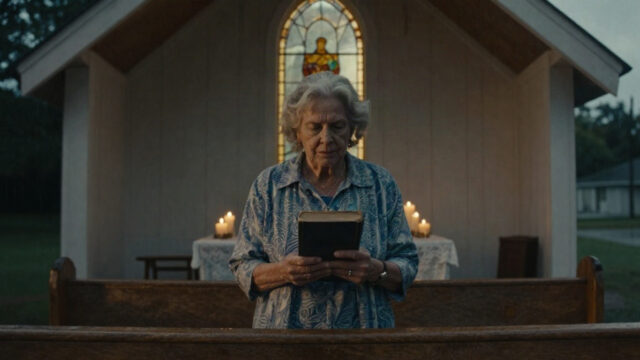
On Christmas Eve, the snow came down soft and steady on Lincoln Village. It stuck to the windshields and made the streetlights look like they were wearing halos. I had been playing the organ at St. Hedwig’s since 1984, and I had never once been nervous before a service. That night my hands would not stop shaking as I pulled out the stops for the prelude.
I kept my eyes on the back doors while I played. The church filled slowly, families stamping snow off their boots, children in red velvet dresses, old men in their good wool coats. At 9:55 the doors opened and a tall woman came in with white hair pinned back and a camel coat over her arm. She stood in the narthex for a long moment, looking at the altar and the candles. Then she walked down the center aisle and sat in the front pew.
Stanley was already there. He had come early and sat on the aisle, his hat in his lap. When Ruthellen sat down beside him, he did not look at her. He only moved his hands so that the hat rested between them, and I saw his shoulders loosen a little.
The Mass went on the way it always did, with the incense and the readings and the homily about the light coming into the dark. I played “O Little Town of Bethlehem” and “Silent Night,” and my fingers kept finding the right keys without my asking them to. When the last carol ended and the congregation began to rise, Stanley stood up slowly and walked to the chancel steps.
He did not go to the pulpit. He stood on the bottom step with his hands at his sides and cleared his throat. The church went quiet in a way I had never heard it go quiet.
“My name is Stanley Kowalczyk,” he said. “Most of you have known me all my life. I want to tell you something about my mother and my father, and about a little girl who was born at St. Joseph’s Hospital on March 9, 1958.”
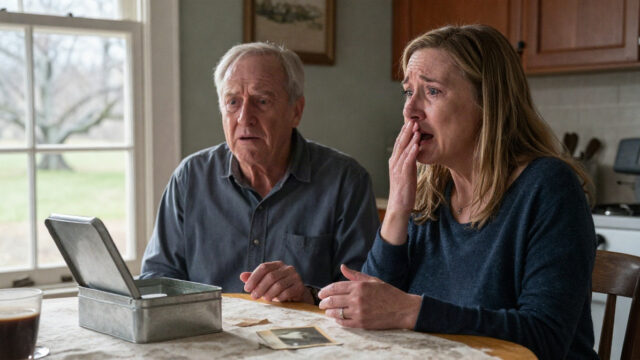
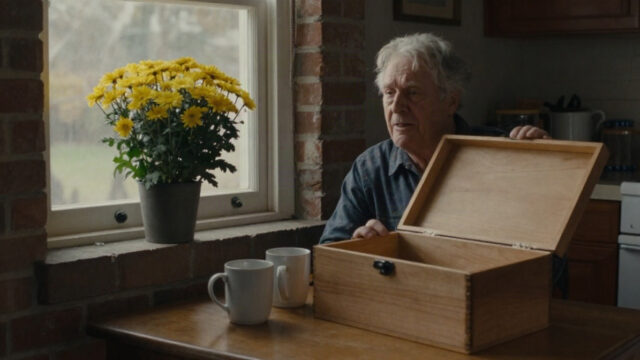
He told them. He told them about Mama’s grief and Daddy’s silence, about the closed casket and the Mass for a baby who was not in it. He told them about the papers in the desk drawer and the registry and the twenty-six letters in a shoebox. He did not make excuses for himself, and he did not raise his voice. When he was finished, he turned and looked straight at me in the organ loft.
“Lois,” he said, “I lied to you. I was afraid of what our family would look like, and I let that be more important than you. I am asking you to forgive me.”
Every face in the church turned toward the loft. My throat was tight, and my palms were damp on the organ bench. I thought about Mama’s shaking handwriting and Daddy’s boots on the floor and my brother at five years old on the back steps, promised silence by a grieving man who did not know what else to do.
I stood up. Then I came down the loft stairs, one step at a time, and walked down the center aisle in my church shoes with the whole parish watching. I did not stop at Stanley. I went straight to the front pew and sat down beside Ruthellen and took her hand, which was warm and a little trembling.
“I forgive you, Stanley,” I said, not turning my head. “And I am telling the truth now, too. I am not going to hide that Mama had a daughter who lived. I am going to say her name out loud.”
Stanley let out a long breath and sat down in the pew behind us. I heard him weeping quietly into his hat.
The parish stayed still for a moment. Then Father Brandt came down from the altar in his white vestments and stood at the end of our pew with his hands folded. He said a blessing over all of us, and I felt something settle in my chest that I had not known was weighing on me.
We walked out together after the benediction, the three of us, into the snow. Ruthellen wrapped her camel coat tight and looked up at the sky, catching the flakes on her lashes. Stanley stood at the top of the steps with his hat on again, looking older and lighter both at once.
We sat down on the cold stone steps, not caring about the wet. The streetlights glowed. Ruthellen looked at me and smiled, then at Stanley, and then back at me.
“Mama always told me my name was Ruthellen Grace,” she said softly. “She said it was the one thing nobody could take from me.”
This is a work of fiction. Names, characters, places and events are products of the author’s imagination; any resemblance to actual persons or events is purely coincidental. Images are illustrations.