My Brother Wanted to Sell Our Father’s Orchard. Then I Found Out Dad Had Another Family
I took the ledgers and the bank records to a lawyer in Yakima named Ruben Castellano. His office was above a bakery on Yakima Avenue. He read every page without speaking, then took off his glasses and rubbed his eyes.
“Your mother’s estate passes to you and your brother, equal shares,” he said. “But Blue Ridge was never just hers. And a child with proof of paternity has a claim, Mrs. Quintanilla. Probably a good one.”
“So what do we do?”
“You talk to your brother,” Ruben said. “And you talk to the girl before someone else does.”
That evening I found Gil in the orchard barn, sorting old wooden crates by the light of a single bulb. He looked up when I came in and saw the folder in my hand.
I set the ledgers on a crate and laid out the bank statements one by one. I told him about Tomás, the envelopes, and the rent my mother had paid for a girl she never named.
Gil did not argue. He sat down slowly on an upturned bucket and stared at the floor. For a long time there was only the sound of the wind against the metal roof.
“I never wanted to look back,” he finally said. “Dad was a stranger to me most of my life. I figured if I didn’t dig, I couldn’t get hurt.”
“She’s been hurt already, Gil. Elena. Dolores. All of them.”
He nodded without looking up. “I know. I know that.”
We sat there together until the bulb flickered and went out. Then Gil stood, dusted off his jeans, and said, “When do we go to Wenatchee?”
We drove up on a cold morning in March 2027, the frost still white on the fields. Gil drove. Neither of us said much. The developer’s offer, two million one hundred thousand dollars, lay in a folder on the back seat, unsigned.
Elena Varga met us at the door of her small blue house with her arms folded. She had her father’s dark eyes and a careful way of standing. She was fifty-eight years old, and a school lanyard still hung around her neck.
“I don’t want anything from Hector Quintanilla,” she said before we could speak. “My mother made sure of that.”
“We’re not here for anything,” Gil said. “We’re here because we should have been.”
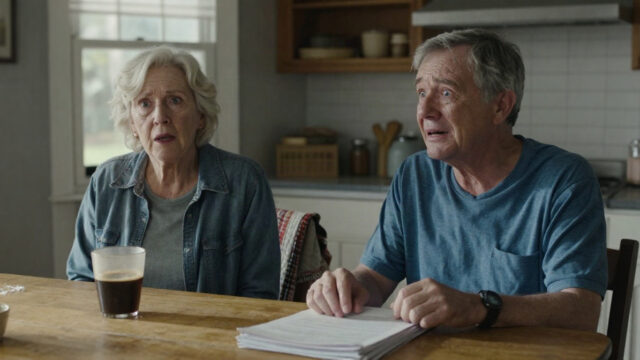
She let us in. Her kitchen was warm and crowded, with children’s drawings taped to the refrigerator and a pot of soup on the stove. We sat at the table, and Elena set down a box of letters tied with ribbon. Our father’s handwriting was on every envelope.
She did not hand them over. She opened the box and let us read the first one, dated 1974, a single page asking Dolores to forgive him. Gil put his big hands flat on the table and cried without making a sound.
Later, while Elena’s youngest grandchild colored at the far end of the table, Gil leaned toward me. “Nora, will you teach me Mom’s apple pie? The one with the lattice top. I want to make it for them.”
I looked at my brother, who had never once in his life asked me for help with anything. “You’ll need cold butter,” I said. “And you can’t rush the dough.”
We agreed on the rest in Elena’s kitchen before we left. Blue Ridge would not be sold. The forty acres would be held in three equal shares, for the Quintanilla siblings and for Elena and her children, and the orchard would keep its name. Ruben would draw up the papers. The developer would hear no from both of us.
The following Saturday, Gil and I stood in the back kitchen of Nora’s Chair with flour on our hands and the radio playing low. He rolled out the bottom crust too thin, and I told him to try again. He laughed, and it sounded like the boy I remembered from long ago.
Outside, the afternoon was going gray over Yakima Avenue. The pie cooled on the rack between us, its lattice top golden and crooked. I thought about my mother, who had written every truth down and then kept it locked in a tin, and I wondered whether she had ever imagined a day like this one.
Some secrets are kept out of fear. Some are kept out of love, and cost a person dearly to keep. I had spent sixty-one years learning which was which, and I was finally ready to set the table for everyone.
This is a work of fiction. Names, characters, places and events are products of the author’s imagination; any resemblance to actual persons or events is purely coincidental. Images are illustrations.