My Sister-in-Law Took My Late Husband’s Pension for 28 Years. I Let Her Think I Didn’t Know
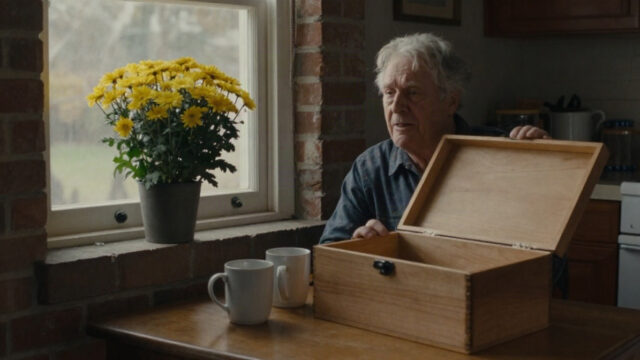
On Tuesday, October 16, I drove out to a farmhouse on the county road north of town. Harold Pruitt was seventy-nine years old and still lived there alone. He came to the door in a cardigan with a hearing aid tucked behind one ear. He waved me inside to the kitchen before I could say much at all.
“I was a notary for twenty-seven years,” he said, loud enough to be heard across the room. “I kept every record. Every signature, every date, every witness. You don’t stamp a paper unless you know who’s in front of you.”
I handed him the photocopy. He put on a pair of reading glasses, held the page close to his face, and went quiet. After a long moment he tapped the line with one finger.
“That’s my writing,” he said. “Ruhl, Lorna, present. Dunaway, Walter, not present.” He looked up at me over the glasses. “I remember that morning. Lorna came in with a form already filled out and said her brother had signed it at home and just needed the stamp. I told her I couldn’t notarize a signature I hadn’t seen.”
“She said her mother was in the hospital and the bank needed it by Friday,” he went on. “She leaned over my desk and said, ‘Harold, you know our family. You know we’re good people.’ And I let her talk me into it.”
“So you never saw Walt?” I asked.
“Never laid eyes on him,” Harold said. “I wrote down the truth in my book because that’s what the book is for. I should have walked away, and I didn’t. I have been ashamed of that for twenty-eight years.”
He wrote out a statement by hand, the way he had written every entry in his life. Then he asked me to type it up so he could sign it before a notary friend of his in Muncie. He signed it with a steady hand, and the bank would later accept it without question.
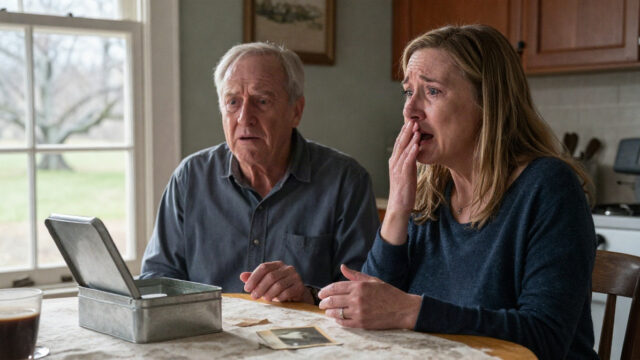
On Thursday, October 22, I asked Lorna to sit with me at her own kitchen table. Dale was at the hardware store, and the house was very quiet. I poured two cups of coffee and set them down. Then I laid the notary’s photocopy and Harold’s signed statement side by side between us.
Lorna looked at the papers for a long time. She did not reach for them.
“I think you should explain this to me,” I said. That was all I said.
For a while she said nothing at all. Then her composure broke, the way a dam does when the water finally finds the crack. “Mama was dying,” she said. “I took care of her for three years. Nobody paid me one dime.”
“Dale was working double shifts, and I was the one changing the sheets at three in the morning,” she said. “Walt was off at the plant with his pension and his nice house, and I thought, he owes me this. We all owe me this.” She pressed her hand over her mouth. “I never meant for it to go on so long. I kept thinking I’d find a way to pay it back. I never did.”
The back door opened, and Dale stepped in, carrying a paper sack of nails. He stopped in the doorway and saw the papers on the table. Without a word he set the sack on the counter, pulled out the chair beside his wife, and sat down. He put his hand flat on the table near hers, not touching it, just there.
I looked at Lorna and kept my voice level. “The pension will be returned to me, Lorna. The bank has already said so. You will sign a repayment agreement, and it will be supervised. But on Sunday, at the potluck, you will make the first payment yourself, in front of the congregation. That is my condition.”
She nodded slowly, her eyes wet. “All right, Pearl.”
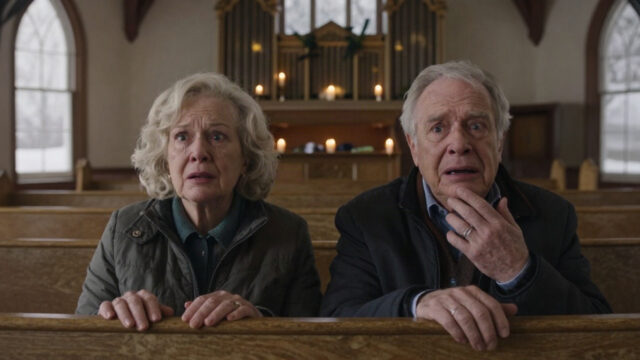
On Sunday morning, October 25, the fellowship hall at First Christian was full of folding tables, casseroles, and the chatter of families. Rev. Nell Okafor was at the coffee urn, smiling at everyone. Lorna came out of the church kitchen with a plain white envelope in her trembling hands, and she walked toward the crowd. Dale followed one step behind her. I was the only one in that room who knew what the envelope contained.
This is a work of fiction. Names, characters, places and events are products of the author’s imagination; any resemblance to actual persons or events is purely coincidental. Images are illustrations.