The Nephew Hid His Uncle’s Last Letter in a Desk Drawer for Two Years
The Harlan Creek Community Hall smelled of baked beans, pine cleaner, and somebody’s cinnamon candles. Folding tables stood in long rows under strings of white lights, and every family in town had brought a dish. By seven o’clock the room was loud with children and the scrape of plastic chairs.
Ellen Cobb, the estate lawyer, had driven up from Knoxville in a silver sedan still dusted with road salt. She set her briefcase on a card table near the stage, opened it, and laid out a stack of documents with careful hands. She was a small woman with reading glasses on a beaded chain, and she did not look like anybody who would let a family cheat their way through a probate.
Carl sat at the end of the front table with his hands clasped on the wood. He had not raised his voice once since the diner. Ruby sat beside him, a little apart, as if she needed room to think.
I had come straight from my shift in my good blue sweater, and I sat with Walter in the second row. He held the brown envelope on his knee and did not open it.
“You’re not going to read it?” I asked him softly.
“I read it two years ago,” he said. “I just didn’t know what I was supposed to do with it. I didn’t want to be the one who took Hollis’s medal away from his family. And I didn’t want to look like a fool for wanting something for myself.”
“What did it say?”
He turned the envelope over in his hands. “You’ll hear it in a minute. Ellen asked me to wait until she had everybody here.”
Ellen cleared her throat and stood. The room quieted, one table at a time, until only the children were still talking.
“Thank you all for coming tonight,” she said. “I’m here because Hollis Dempsey left very specific instructions in his will, and those instructions have been in question since March. I’ve confirmed the signature and the notarization on the letter found in the estate papers. It is valid.”
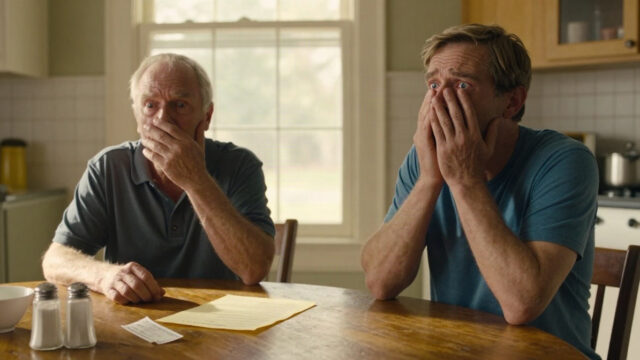
She looked straight at Carl. “Mr. Dempsey has told me he removed that letter from the estate file and kept it in his desk. He has also told me why.”
Carl did not look up. “I was scared,” he said, very low. “I didn’t want to lose the house, or the little bit that was coming to me. I thought it was mine to decide.”
“It wasn’t,” Ellen said, not unkindly. “Walter, would you read the letter, please?”
Walter stood up slowly. His knees popped, and he gave a small embarrassed smile to the room. He unfolded a single sheet of blue stationery, yellowed at the edges, and cleared his throat.
“To Walter Pruitt,” he began, “who came every Sunday when nobody else did. I leave my Silver Star to you because you are the only man I ever knew who asked me how I was doing and then waited for the true answer.”
He paused, then read on. “Keep it with my name in your heart, and see that my brother’s grandchildren know what I did, and why I was never proud of it. I was proud of the two men I carried out. That is the only medal I ever wanted. Hollis Dempsey.”
Nobody moved. Someone at the back of the hall sniffed loudly. Ruby had her hand over her mouth.
Walter folded the letter and held it for a moment. Then he crossed the floor to the card table where Ruby sat and set the envelope down in front of her. Beside it he placed a small walnut case, the one he had carried in from his truck that afternoon, wrapped in a faded flannel shirt.
“Hollis wanted you to have this,” Walter said. “All of you. He asked me to make sure the name stays alive in this family. That’s all I want, Ruby. Keep his name spoken at the table. Tell the story right.”
Ruby lifted the lid of the walnut case with trembling fingers. Under the hall lights the Silver Star gleamed, its white enamel bright against the dark velvet, and the whole room seemed to lean in at once to see it.
Carl got up from his chair and walked slowly to his daughter’s side. He put his hand on her shoulder and did not say a word, and I saw his eyes were full.
Outside, the town’s fireworks crew was setting up on the frozen ball field. The first bursts went off just past midnight, red and gold over the snowy hills, and the crowd rose to its feet with a cheer.
Walter came back to our row and sat down beside me, close enough that our shoulders touched. He reached into the inside pocket of his coat and took out a small box, and I recognized it at once. Inside, on a bed of faded cotton, sat a thin silver ring I had returned to him thirty-seven years before.
“I kept it,” he said, “and I kept the watch you gave me, too. I never could explain that to anybody, not even to myself.” He looked at me with the same patient face I remembered from the first summer. “Joan, would you like to see what else I kept?”
I laughed, and my eyes went hot, and I let him take my hand. Above us the sky broke open in gold. “Walter Pruitt,” I said, “I think you’d better ask me properly.”
He did. And when I said yes, I meant every bit of it. We agreed right there, in the middle of the cheering crowd, to spend the long slow winter ahead together. Some doors you think are shut for good turn out to have been waiting all along, for somebody brave enough to knock.
This is a work of fiction. Names, characters, places and events are products of the author’s imagination; any resemblance to actual persons or events is purely coincidental. Images are illustrations.